

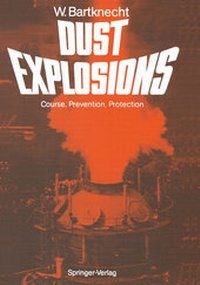
Dust Explosions
Course, Prevention, Protection
Published on 23. December 2011
Book
Paperback/Softback
X, 270 pages
978-3-642-73947-7 (ISBN)
Description
The author summarizes todays knowledge of the cause and consequences of dust explosions which were the main focus of his professional life. The presence of explosible dust/air mixtures does not generally represent a risk of an explosion although all organic and metallic dusts are explosible. The author develops test-methods for explosion hazards associated with dust and constructive methods to prevent dust explosions. The book is written for practical use. The reader learns to recognise the hazard of a dust explosion and the effectiveness of safety measures. The book is richly illustrated and demonstrates the correct use of the empirical theories.
More details
Edition
Softcover reprint of the original 1st ed. 1989
Language
English
Place of publication
Heidelberg
Germany
Publishing group
Springer Berlin
Target group
Professional and scholarly
Research
Illustrations
26 s/w Tabellen, 25 farbige Abbildungen
26 Tables, black and white; 25 Illustrations, color; X, 270 p. 25 illus. in color.
Dimensions
Height: 24.2 cm
Width: 17 cm
Weight
491 gr
ISBN-13
978-3-642-73947-7 (9783642739477)
DOI
10.1007/978-3-642-73945-3
Schweitzer Classification
Other editions
Additional editions
Book
10/1989
1st Edition
Springer
€119.99
Article exhausted; check different version

Book
07/1987
1st Edition
Springer
€49.99
Article exhausted; check different version
Persons
Content
1 Introduction.- 2 Historical Review.- 2.1 Occurrence of Dust Explosions.- 2.2 The Nature of Dust Explosions.- 2.3 Apparatus for the Testing of Airborne Dusts.- 3 Dust as a Dispersed Substance.- 4 Material Safety Specifications.- 4.1 Preliminary Remarks.- 4.2 Material Safety Specifications of Dust Layers (G. Zwahlen).- 4.2.1 Flammability.- 4.2.2 Burning Behavior.- 4.2.2.1 Combustibility Test at Room Temperature.- 4.2.2.2 Combustibility Test at Elevated Temperature.- 4.2.2.3 Burning Rate Test.- 4.2.3 Deflagration.- 4.2.3.1 Screening Test for Deflagration.- 4.2.3.2 Laboratory Test for Deflagration.- 4.2.4 Smolder Temperature.- 4.2.4.1 Determination of the Smolder Temperature.- 4.2.5 Autoignition.- 4.2.5.1 Determination of the Relative Autoignition Temperature, as per Grewer.- 4.2.5.2 Hot Storage Test in the Wire Mesh Basket.- 4.2.6 Exothermic Decomposition.- 4.2.6.1 Determination of the Exothermic Decomposition Temperature in an Open Vessel, as per Lütolf.- 4.2.6.2 Determination of an Exothermic Decomposition in an Oven Purged with Nitrogen, as per Grewer.- 4.2.6.3 Differential Thermal Analysis.- 4.2.6.4 Determination of an Exothermic Decomposition Under Choked Heat Flow.- 4.2.7 Explosibility.- 4.2.7.1 Impact Sensitivity.- 4.2.7.2 Friction Sensitivity.- 4.2.7.3 Thermal Sensitivity.- 4.3 Material Safety Specifications for Dust Clouds Describing the Explosion Behavior.- 4.3.1 Combustible Dusts.- 4.3.1.1 Preliminary Remarks.- 4.3.1.2 Particle Size Distribution.- 4.3.1.3 Explosibility.- 4.3.1.4 Explosible Limits.- 4.3.1.5 Explosion Pressure Versus Explosion Violence.- 4.3.2 Flock.- 4.3.2.1 Preliminary Remarks.- 4.3.2.2 Explosible Limits.- 4.3.2.3 Explosion Pressure/Violence of Explosion.- 4.3.3 Hybrid Mixtures.- 4.3.3.1 Preliminary Remarks.- 4.3.3.2 Explosible Limits.- 4.3.3.3 Explosion Pressure /Violence of Explosion.- 4.3.4 Conclusions.- 4.4 Safety Characteristics of Airborne Dust Describing the Ignition Behavior.- 4.4.1 Minimum Ignition Energy.- 4.4.1.1 Preliminary Remarks.- 4.4.1.2 Apparatus for the Determination of the Minimum Ignition Energy.- 4.4.1.3 Ignition Behavior of Combustible Dusts.- 4.4.1.4 Ignition Behavior of Flock.- 4.4.1.5 Ignition Behavior of Hybrid Mixtures.- 4.4.1.6 Conclusions.- 4.4.2 Ignition Temperature.- 4.4.2.1 Preliminary Remarks.- 4.4.2.2 Apparatus for Temperature Determination.- 4.4.2.3 Ignition Effectiveness of a Glowing Coil.- 4.4.2.4 Conclusions.- 4.5 Safety Characteristics of Airborne Dusts Describing the Course of an Explosion in Pipelines.- 5 Protective Measures Against the Occurrence and Effects of Dust Explosions.- 5.1 Preliminary Remarks.- 5.2. Preventive Explosion Protection.- 5.2.1 Preliminary Remarks.- 5.2.2 Prevention of Explosible Dust/Air Mixtures.- 5.2.3 Prevention of Dust Explosions by Using Inert Matter.- 5.2.3.1 Admixture of Nitrogen.- 5.2.3.1.1 Preliminary Remarks.- 5.2.3.1.2 Combustible Dusts.- 5.2.3.1.3 Hybrid Mixtures.- 5.2.3.1.4 UseofVacuum.- 5.2.3.1.5 Admixture of Solids.- 5.2.4 Prevention of Effective Ignition Sources.- 5.2.4.1 Preliminary Remarks.- 5.2.4.2 Mechanically Generated Sparks.- 5.2.5 Hot Surfaces/Autoignition.- 5.2.6 Static Electricity.- 5.2.7 Conclusions.- 5.3 Explosion Protectio`n Through Design Measures.- 5.3.1 Preliminary Remarks.- 5.3.2 Explosion Pressure-resistant Design for the Maximum Explosion Pressure.- 5.3.2.1 Explosion Pressure-resistant Design.- 5.3.2.2 Explosion Pressure Shock-resistant Design.- 5.3.3 Explosion Pressure-resistant Design for a Reduced Maximum Explosion Pressure in Conjunction with Explosion Pressure Venting.- 5.3.3.1 Preliminary Remarks.- 5.3.3.2 Explosion Pressure Venting of Vessels.- 5.3.3.3 Explosion Pressure Venting of Elongated Vessels (Silos).- 5.3.3.4 Explosion Pressure Venting of Pipelines.- 5.3.4 Explosion-resistant Construction for Reduced Maximum Explosion Pressure in Conjunction with Explosion Suppression.- 5.3.5 Technical Diversion or Arresting of Explosions.- 5.3.5.1 Preliminary Remarks.- 5.3.5.2 Extinguishing Barrier.- 5.3.5.3 RotaryAir Locks (Rotary Valves).- 5.3.5.4 Rapid-Action Valves: Gate or Butterfly Type.- 5.3.5.5 Rapid-Action Valve: Float Type.- 5.3.5.6 Explosion Diverter.- 5.3.6 Conclusions.- 6 Concluding Remarks.- 7 Acknowledgements.- 8 Appendix.- 8.1 Explosion Pressure Venting.- 8.1.1 Vessel: Area Determination by Calculation or Nomogram.- 8.1.2 Elongated Vessels (Silos).- 9 References.- 10 Symbols and Abbreviations.- 11 Conversion Factors.- 12 Subject Index.