

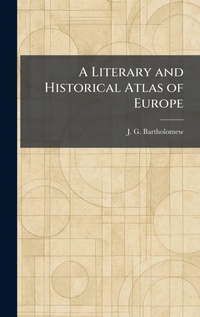
A Literary and Historical Atlas of Europe
Description
"A Literary and Historical Atlas of Europe" is a comprehensive reference work designed to illustrate the evolving landscape of the European continent through both time and literature. Compiled by the renowned cartographer J. G. Bartholomew, this atlas provides a unique visual narrative of the historical and cultural shifts that have shaped Europe.
The volume features a rich collection of maps detailing political boundaries, battlefields, and the geographical settings of significant literary works. Beyond simple topography, the atlas explores the intersection of place and story, offering insights into the environments that inspired great writers and the historical events that redefined nations. Readers will find detailed plates covering various eras, from ancient times through the early 20th century, alongside a gazetteer and specialized maps that focus on specific historical periods or literary themes.
This work remains an invaluable resource for students of history, literature, and geography, bridging the gap between physical space and human achievement. It serves as a testament to the importance of spatial context in understanding the complex tapestry of European heritage.
This work has been selected by scholars as being culturally important, and is part of the knowledge base of civilization as we know it. This work was reproduced from the original artifact, and remains as true to the original work as possible. Therefore, you may see the original copyright references, library stamps (as most of these works have been housed in our most important libraries around the world), and other notations in the work.
This work is in the public domain in the United States of America, and possibly other nations. Within the United States, you may freely copy and distribute this work, as no entity (individual or corporate) has a copyright on the body of the work.
As a reproduction of a historical artifact, this work may contain missing or blurred pages, poor pictures, errant marks, etc. Scholars believe, and we concur, that this work is important enough to be preserved, reproduced, and made generally available to the public. We appreciate your support of the preservation process, and thank you for being an important part of keeping this knowledge alive and relevant.