

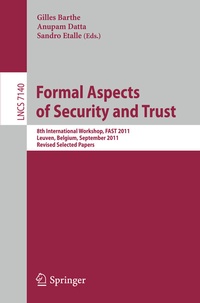
Formal Aspects of Security and Trust
8th International Workshop, FAST 2011, Leuven, Belgium, September 12-14, 2011. Revised Selected Papers
1st Edition
Published on 4. May 2012
Book
Paperback/Softback
X, 279 pages
978-3-642-29419-8 (ISBN)
Description
This book constitutes the thoroughly refereed post-conference proceedings of the 8th International Workshop on Formal Aspects of Security and Trust, FAST 2011, held in conjunction with the 16th European Symposium on Research in Computer Security, ESORICS 2011, in Leuven, Belgium in September 2011. The 15 revised full papers presented together with 2 invited papers were carefully reviewed and selected from 42 submissions. The papers focus on security and trust policy models; security protocol design and analysis; formal models of trust and reputation; logics for security and trust; distributed trust management systems; trust-based reasoning; digital assets protection; data protection; privacy and ID issues; information flow analysis; language-based security; security and trust aspects of ubiquitous computing; validation/analysis tools; web service security/trust/privacy; grid security; security risk assessment; and case studies.
More details
Series
Language
English
Place of publication
Berlin
Germany
Publishing group
Springer Berlin
Target group
Professional and scholarly
Research
Illustrations
51 s/w Abbildungen
X, 279 p. 51 illus.
Dimensions
Height: 23.5 cm
Width: 15.5 cm
Weight
445 gr
ISBN-13
978-3-642-29419-8 (9783642294198)
DOI
10.1007/978-3-642-29420-4
Schweitzer Classification
Other editions
Additional editions
Gilles Barthe | Anupam Datta | Sandro Etalle
Formal Aspects of Security and Trust
8th International Workshop, FAST 2011, Leuven, Belgium, September 12-14, 2011. Revised Selected Papers
E-Book
06/2012
Springer
€53.49
Available for download
Content
Security and trust policy models.- security protocol design and analysis.- formal models of trust and reputation.- logics for security and trust.- distributed trust management systems.- trust-based reasoning.- digital assets protection.- data protection.- privacy and ID issues.- information flow analysis.- language-based security.- security and trust aspects of ubiquitous computing.- validation/analysis tools.- web service security/trust/privacy.- grid security.- security risk assessment.- case studies.