

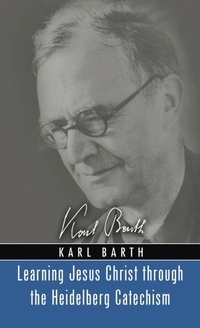
Learning Jesus Christ through the Heidelberg Catechism
Published on 7. August 2020
Book
Hardback
142 pages
978-1-7252-6473-1 (ISBN)
Description
""The Heidelberg Catechism does not represent a different theological orientation... here the Reformed Church confesses the good news of Jesus Christ in. a joyful, thankful, free, personal way . . . Barth has caught this spirit in his commentary. To read it is to become acquainted with a side of Reformed Protestantism which all too often has remained hidden.""
- from the Preface
The two short studies by renowned theologian Karl Barth included here were first published in 1964, the 400th anniversary of the Heidelberg Catechism--a classical document of the Reformation Period.
Students, ministers, laypersons, and theologians continue to find these essays helpful, for they provide not only an introduction to the Heidelberg Catechism, but also a brief, systematic presentation of Reformed theology in the 16th century and a glimpse of Barth's own theology on the 20th century.
The first essay, ""Christian Doctrine According to the Heidelberg Catechism,"" is a question by question interpretation, commentary, and evaluation of the catechism. ""Introduction to the Heidelberg Catechism,"" the second essay, examines the three basic questions of the document: Who is the Comforter? Who is comforted? and How is comfort given and in what does it consist?
More details
Language
English
Place of publication
United States
Product notice
sewn/stitched
Cloth over boards
With dust jacket
Dimensions
Height: 222 mm
Width: 145 mm
Thickness: 11 mm
Weight
319 gr
ISBN-13
978-1-7252-6473-1 (9781725264731)
Copyright in bibliographic data and cover images is held by Nielsen Book Services Limited or by the publishers or by their respective licensors: all rights reserved.
Schweitzer Classification
Persons
'He undoubtedly is one of the giants in the history of theology.' -Christianity Today
Karl Barth was described by Pope Pius XII as the most important theologian since Thomas Aquinas, the Swiss Pastor and Theologian, and Barth continues to be a major influence on students, scholars and preachers. Barth's theology found its expression mainly through his closely reasoned fourteen part magnum opus, Die Kirchliche Dogmatik. Having taken over 30 years to write, the Church Dogmatics is regarded as one of the most important theological works of all time, and represents the pinnacle of Barth's achievements as a theologian.