

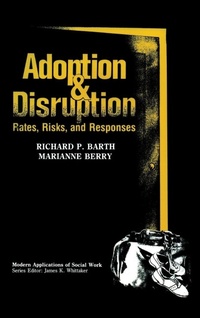
Adoption and Disruption
Rates, Risks, and Responses
1st Edition
Published on 31. December 1988
Book
Hardback
262 pages
978-0-202-36049-2 (ISBN)
Description
First Published in 2017. In this book the authors move easily and often between the worlds of policy, practice, and research in child and family welfare. Their own research delineates- better than any other to date- the particular factors associated with success>ful and unsuccessful older, special-needs adoptions.
More details
Language
English
Place of publication
Somerset
United States
Publishing group
Taylor & Francis Inc
Target group
College/higher education
Professional and scholarly
Dimensions
Height: 235 mm
Width: 157 mm
Thickness: 19 mm
Weight
535 gr
ISBN-13
978-0-202-36049-2 (9780202360492)
Copyright in bibliographic data and cover images is held by Nielsen Book Services Limited or by the publishers or by their respective licensors: all rights reserved.
Schweitzer Classification
Other editions
Additional editions
Book
03/2023
1st Edition
AldineTransaction
€58.30
Shipment within 10-15 days
E-Book
11/2017
Routledge
€51.49
Available for download
E-Book
11/2017
Routledge
€51.49
Available for download
Persons
Richard P. Barth, a fost-adopt father, is Associate Professor, Associate Director of the Family Welfare Research Group, and Chairman of the School Social Work Program, in the School of Social Welfare at the University of California, Berkeley. Marianne Berry is a doctoral candidate in Social Welfare at the University of California, Berkeley.
Content
Part I. Older Child Adoption Now 1 Overview of Older Child Adoption and Disruption 3 2 The Value of Adoption and Disruption 23 3 A Social and Cognitive Model of Adjustment to Adoption 43 Part II. The Study 4 Disruption Research: Past and Present 69 5 Predicting Disruptions 39 6 Preplacement Assessment and Decision Making 103 7 Birth and Adoptive Parents 123 8 The Children: History, Behavior, and Attachment 129 9 Social Worker Characteristics and Services 145 10 Discriminating Disruptions from Intact Placements 155 Part III. Implications of the Study 11 The Path to Disruption 167 12 Practice Implications 185 13 Policy and Program Implications