

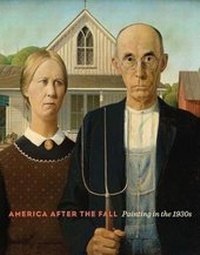
America after the Fall
Painting in the 1930s
Published on 7. June 2016
Book
Hardback
204 pages
978-0-300-21485-7 (ISBN)
Description
A unique look at America's quest to carve out an artistic identity during the Depression era
Through 50 masterpieces of painting, this fascinating catalogue chronicles the turbulent economic, political, and aesthetic climate of the 1930s. This decade was a supremely creative period in the United States, as the nation's artists, novelists, and critics struggled through the Great Depression seeking to define modern American art. In the process, many painters challenged and reworked the meanings and forms of modernism, reaching no simple consensus. This period was also marked by an astounding diversity of work as artists sought styles-ranging from abstraction to Regionalism to Surrealism-that allowed them to engage with issues such as populism, labor, social protest, and to employ an urban and rural iconography including machines, factories, and farms.
Seminal works by Edward Hopper, Grant Wood, Thomas Hart Benton, Georgia O'Keeffe, Aaron Douglas, Charles Sheeler, Stuart Davis, and others show such attempts to capture the American character. These groundbreaking paintings, highlighting the relationship between art and national experience, demonstrate how creativity, experimentation, and revolutionary vision flourished during a time of great uncertainty.
Distributed for the Art Institute of Chicago
Exhibition Schedule:
The Art Institute of Chicago
(06/05/16-09/18/16)
Musee de l'Orangerie, Paris
(10/15/16-01/30/17)
Royal Academy of Arts, London
(02/25/17-06/04/17)
Through 50 masterpieces of painting, this fascinating catalogue chronicles the turbulent economic, political, and aesthetic climate of the 1930s. This decade was a supremely creative period in the United States, as the nation's artists, novelists, and critics struggled through the Great Depression seeking to define modern American art. In the process, many painters challenged and reworked the meanings and forms of modernism, reaching no simple consensus. This period was also marked by an astounding diversity of work as artists sought styles-ranging from abstraction to Regionalism to Surrealism-that allowed them to engage with issues such as populism, labor, social protest, and to employ an urban and rural iconography including machines, factories, and farms.
Seminal works by Edward Hopper, Grant Wood, Thomas Hart Benton, Georgia O'Keeffe, Aaron Douglas, Charles Sheeler, Stuart Davis, and others show such attempts to capture the American character. These groundbreaking paintings, highlighting the relationship between art and national experience, demonstrate how creativity, experimentation, and revolutionary vision flourished during a time of great uncertainty.
Distributed for the Art Institute of Chicago
Exhibition Schedule:
The Art Institute of Chicago
(06/05/16-09/18/16)
Musee de l'Orangerie, Paris
(10/15/16-01/30/17)
Royal Academy of Arts, London
(02/25/17-06/04/17)
Reviews / Votes
Selected by Choice as an Outstanding Academic Title for 2016 ChoiceMore details
Language
English
Place of publication
United States
Product notice
Cloth over boards
Illustrations
105 color + 15 b-w illus.
Dimensions
Height: 305 mm
Width: 238 mm
Weight
1497 gr
ISBN-13
978-0-300-21485-7 (9780300214857)
Copyright in bibliographic data and cover images is held by Nielsen Book Services Limited or by the publishers or by their respective licensors: all rights reserved.
Schweitzer Classification
Persons
Judith A. Barter is Field-McCormick Chair and Curator of American Art, Annelise K. Madsen is assistant curator of American art, and Sarah Kelly Oehler is Gilda and Henry Buchbinder Associate Curator of American Art, all at the Art Institute of Chicago. Sarah L. Burns is professor emerita at Indiana University. Teresa A. Carbone is program director for American art at the Henry Luce Foundation.