

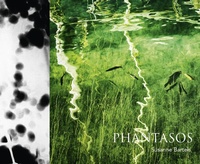
PHANTASOS
1st Edition
Published on 9. February 2026
Book
Paperback/Softback
64 pages
978-3-69133-017-5 (ISBN)
Unfortunately, price unknown
Available (delivery time upon request)
Not available
Description
Eating an orange, maybe two I look at the white wall in front of me. This is the concrete reality before my eyes: a white wall. But then I close my eyes and see this white wall through my imagination. Suddenly, it seems blue to me; and then yellow; I imagine it stripped of colour and bearing all known colours I can think of; then I imagine new colours and paint the wall in shades that have not yet been named. I also imagine that the wall is not even a wall, but merely a mantle of colour. What would it be like to touch a pure, immaterial colour, to hold it between my fingers? I grow tired of imagining colours and open my eyes. The white wall is still before me, materially real. But I don't feel like seeing whiteness, so I close my eyes again. And then I begin to see the white wall through memory. In my memory, the wall is still white. But it has a window. There was a time when the wall had a window; a time when there was a gap in the whiteness. A time when I looked through that window at the world beyond the wall; the whiteness was only a frame surrounding the fragment of the world I could see. In my memory, the window is open; a soft breeze enters the room, carrying with it a scent of fruit. Oranges. I open my eyes suddenly and face the whiteness. The window has vanished. But I still feel the breeze on my face, I still smell the oranges. As if the wall still had an open window. Here's what I think: the invisible window represents the gap between reality and memory. I smile at the white wall. And then I have a new thought: reality is always out of sync. And I smile again. But the wall does not smile back. I keep looking at the white wall until my eyes close on their own. Until they grow tired of the whiteness; or is it of the emptiness? I fall asleep. And of course, I dream of the white wall. In the dream, the window becomes a door. The door represents the possibility of crossing over; the wall ceases to be a wall and becomes a bridge. The obstacle turns into an invitation. I accept the invitation and set off across the bridge. Beyond the wall there is a forest. Trees upon trees upon trees. I walk among them in search of oranges, following the trail of the scent. But they are another kind of tree, the kind that bears no fruit. Still, I keep feeling the scent of oranges. At first, I look at each tree one by one, as though walking through a city and gauging which of the people I encounter might be someone I should know; as if I were trying to recognise someone by looking each person in the eye. But where are the eyes of trees? And suddenly I wonder: what might each of these trees - all seeming so similar to me - be thinking, imagining, dreaming? I look closely, but important answers are rarely visible to the eye. Perhaps I could ask one tree: what are you thinking? And turn to the next one: what do you fantasise about? And another: what was your last dream? And another: what do you imagine when you are alone? Ah, but I am never alone, that tree would reply, surrounded by hundreds of other trees. Their branches visibly touching. Their roots probably touching. Their breathing certainly touching. So close to one another, all these trees. Might their thoughts also touch, as their roots do? And their dreams? How does a tree distinguish its own dream from another tree's dream? Or perhaps trees do not mind sharing their dreams with one another. Or perhaps trees share only one common dream, to which they all contribute. Does loneliness exist in the heart of a forest, or is that an impossibility? Can a tree feel lonely when its branches touch the branches of another tree? I think about this as I walk. The trees do not react to my presence; they do not react to my questions; they do not react to my existence. I walk among the trees, and I am the one who feels alone. I wake up. The white wall is in front of me. An impenetrable reality. I smell oranges. I ask myself: why did I dream of trees? Asking questions can be like talking to a wall. No answers come, because walls do not speak. Or perhaps the wall's silence is compensated by the answers that arise from imagination, memory, dream. Reality converses with the immaterial, and a dialogue is born. I look at the white wall in front of me. Perhaps this wall is like a canvas on which I can reproduce what I remember, what I imagine, what I dream. Perhaps reality itself is a canvas onto which what has been lived, imagined, and dreamed can be projected. Reality is like a support, a structure: it needs to be complemented. A container: it needs to be filled. Reality must be remembered, imagined, and dreamed; at all times. Otherwise, it is merely something neutral. Like a wall; a solid, tree-less wall. But I also need anchors: safe points upon which I can rest amid the constant voracity of stimuli that come from imagination and dream and memory. Reality is my anchor. I smile as I look at the white wall. I feel like eating an orange, maybe two.
More details
Edition
limitierte Auflage, nummeriert und handsigniert
Language
English
Place of publication
München
Germany
Target group
Das Buch richtet sich an ein kunst- und fotointeressiertes Publikum sowie an Käufer hochwertiger Fotobücher. Es spricht insbesondere Liebhaber zeitgenössischer Kunstfotografie, Sammler, Galeriebesucher und Besucher von Museen an. Phantasos eignet sich für Leserinnen und Leser, die sich für konzeptuelle Schwarzweißfotografie und künstlerische Bildserien interessieren. Das Buch ist als zeitgenössisches Kunstfotobuch positioniert und für den Kunst- und Fotobuchhandel sowie das galerienahe Umfeld geeignet.
Edition type
New edition
Product notice
Klappenbroschur
sewn/stitched
Illustrations
54
The Phantasos Condition In this project, the myth of Phantasos becomes a guiding framework to explore the fragile border between dream and reality. Phantasos, the dream-bringer of forms, calls landscapes, stones, water, and clouds into the realm of vision. His presence lingers in reflections, shadows, and fleeting surfaces that awaken the inanimate within dreams. Colored reflections - fluid, shifting, ephemeral - embody the dreamlike inventions of perception, while black-and-white images anchor . . .
Dimensions
Height: 24 cm
Width: 30 cm
Weight
435 gr
ISBN-13
978-3-69133-017-5 (9783691330175)
Schweitzer Classification
Person
Author
Fotografin, Apothekerin
"Phantasos" ist ein fotografisches Schwarzweiß-Kunstbuch von Susanne Bartels. Die Publikation versammelt eine Serie inszenierter und dokumentarischer Fotografien, die sich mit Themen wie Wahrnehmung, Identität, Maskierung und Spiegelung auseinandersetzen. Das Buch ist als künstlerische Bildstrecke konzipiert und richtet sich an ein kunst- und fotointeressiertes Publikum.
"Phantasos" ist ein fotografisches Schwarzweiß-Kunstbuch von Susanne Bartels. Die Publikation versammelt eine Serie inszenierter und dokumentarischer Fotografien, die sich mit Themen wie Wahrnehmung, Identität, Maskierung und Spiegelung auseinandersetzen. Das Buch ist als künstlerische Bildstrecke konzipiert und richtet sich an ein kunst- und fotointeressiertes Publikum.