

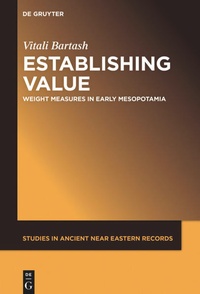
Establishing Value
Weight Measures in Early Mesopotamia
1st Edition
Published on 4. June 2019
Book
Hardback
XVIII, 270 pages
978-1-5015-1714-3 (ISBN)
Description
This book explores the reasons for which weights and scales were used to measure goods in Early Mesopotamia (ca. 3,200-2,000 BCE). The vast corpus of cuneiform records from this period sheds light on the various mechanisms behind the development of this cultural innovation. Weighing became the means of articulating the value of both imported and locally-produced goods within a socioeconomic system that had reached an unprecedented level of complexity. This study provides a comprehensive analysis of this cultural and economic phenomenon, which simultaneously reflected and shaped the relationships between individuals and groups in Mesopotamia throughout the third millennium BCE.
Reviews / Votes
"Vitali Bartash has done an excellent job in bringing together and clarifying the cuneiform evidence for balance weights and the process of weighing in Mesopotamia in the late fourth through the third millennium BCE. The volumeis a must-read for anyone studying ancient mensuration and anyone interested in measurement systems in general." William B. Hafford in: Akkadica 140, 2019,85-94
More details
Series
Language
English
Place of publication
Boston
United States
Target group
Professional and scholarly
US School Grade: College Graduate Student
Illustrations
13 Abbildungen, 33 s/w Tabellen
13 ill., 33 tbl.
Dimensions
Height: 236 mm
Width: 160 mm
Thickness: 22 mm
Weight
587 gr
ISBN-13
978-1-5015-1714-3 (9781501517143)
Schweitzer Classification
Other editions
Additional editions
E-Book
06/2019
1st Edition
De Gruyter
€134.95
Available for download
E-Book
06/2019
1st Edition
De Gruyter
€134.95
Available for download
Person
Vitali Bartash
, Ludwig Maximilian University of Munich.