

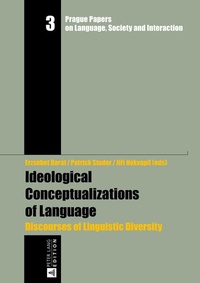
Ideological Conceptualizations of Language
Discourses of Linguistic Diversity
Published on 16. August 2013
Book
Hardback
283 pages
978-3-631-61459-4 (ISBN)
Description
This book presents cutting-edge research into the complex interrelationships between linguistic diversity and ideology. It provides insight into how institutions and individual stakeholders carry ideologies forward into the discursive space through policies, propaganda or individual perceptions and reflections. The chapters focus on different European localities (UK, Central Europe, Switzerland, Luxembourg, Netherlands and Italy), social actors (migrant communities, citizens, and policy-makers), and institutional contexts such as public bodies (European, national) and private enterprises. Understanding ideology as a social act of conceptualization, the book contributes to the growing interdisciplinary body of linguistic research into the social theory of meaning and change.
More details
Other editions
Additional editions
Erzsébet Barát | Patrick Studer | Jirí Nekvapil
Ideological Conceptualizations of Language
Discourses of Linguistic Diversity
E-Book
11/2013
200th Edition
Peter Lang Verlag
€81.59
Available for download
Persons
Erzsébet Barát is Associate Professor of Gender Studies and Social Linguistics at the University of Szeged (Hungary). Her research interests cover critical studies of discourse, relational models of identity, the relationship between language, power and ideology, and feminist critical theory.
Patrick Studer is Professor of Applied Linguistics at Zurich University of Applied Sciences (Switzerland). He takes a particular interest in style as a theoretical concept as well as a perspective that can be applied to a wide range of communicative contexts involving the diffusion and transformation of knowledge.
Jirí Nekvapil is Associate Professor at the Institute of General Linguistics at Charles University in Prague (Czech Republic), where he specializes in sociolinguistics and discourse analysis. His current research focuses on multilingual practices in companies, language management, and the structures of relevance in biographic narratives.
Content
Contents: Erzsebet Barat/Patrick Studer/Jiri Nekvapil: Approaching the study of language use and ideology: An introduction - John B. Trumper/Marta Maddalon: Local - global - glocal: Trends in the creation of linguistic prestige and ideology - Rik Vosters: Dutch, Flemish, or Hollandic? Social and ideological aspects of linguistic convergence and divergence during the United Kingdom of the Netherlands (1815-1830) - Julia de Bres: Language ideologies for constructing inclusion and exclusion: Identity and interest in the metalinguistic discourse of cross-border workers in Luxembourg - Jiri Nekvapil/Tamah Sherman: Language ideologies and linguistic practices: The case of multinational companies in Central Europe - Jaine Beswick: Ideology and language: Assumed and authentic linguistic practices of Portuguese migrants in workspaces on Jersey - Vit Dovalil: Ideological positioning in legal discourses on European multilingualism: Equality of languages as an ideology and a challenge - Mi-Cha Flubacher: Language(s) as the key to integration? The ideological role of diglossia in the German-speaking region of Switzerland - Patrick Studer: Management of language ideologies in informal language planning episodes - Erzsebet Barat: The differentiation of linguistic and cultural diversity: A critical analysis of ideological investments of migrants' desire for belonging - Patrick Studer: In dialogue with Ivana Markova: Linguistics and social representations.