

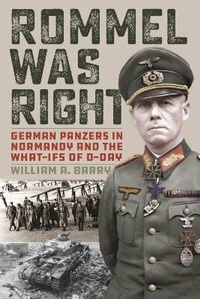
Rommel Was Right
German Panzers in Normandy and the What-Ifs of D-Day
Book
Hardback
400 pages
978-0-8117-3832-3 (ISBN)
Description
One of the enduring controversies of D-Day and the Normandy campaign-one of the most tantalizing what-ifs for military historians and armchair generals-is how the Germans positioned their armored forces to meet the Allied invasion of June 6, 1944. During the months before the Allies landed, Field Marshal Erwin Rommel argued for placing the panzers (the core of German strength) as close to the beaches as possible; he believed that the campaign would be won or lost in the first forty-eight hours, that the panzers needed to be brought to bear as early as possible, and that Allied airpower would prevent armored forces located farther inland from reaching the beachhead quickly. Other German generals argued for a central panzer reserve hidden near Paris, which could mount a massive counterattack; this was how tanks tended to be used on the Eastern Front, and after all, the Germans did not know just where the Allies would attack. Often indecisive, Hitler split the difference, giving Rommel control of three panzer divisions, holding four in reserve inland (under Hitler's personal control), and moving three to the south of France.
On D-Day, while Hitler slept and was slow to release the reserves, only one panzer division-the 21st, in Rommel's group-was able to counterattack the Allies. This lone division reached the channel, splitting Juno and Sword Beaches, but committed to the battle too late, and unsupported, it had to withdraw at day's end. That division's presence near the city of Caen during the weeks to come helped ensure the Allies, who had planned to capture that vital location on D-Day, would not take it until the middle of July.
Rommel Was Right asks what if the Germans had followed Rommel's advice and placed their panzer reserves closer to the beaches.
On D-Day, while Hitler slept and was slow to release the reserves, only one panzer division-the 21st, in Rommel's group-was able to counterattack the Allies. This lone division reached the channel, splitting Juno and Sword Beaches, but committed to the battle too late, and unsupported, it had to withdraw at day's end. That division's presence near the city of Caen during the weeks to come helped ensure the Allies, who had planned to capture that vital location on D-Day, would not take it until the middle of July.
Rommel Was Right asks what if the Germans had followed Rommel's advice and placed their panzer reserves closer to the beaches.
More details
Language
English
Place of publication
Mechanicsburg, Pennsylvania
United States
Illustrations
24 Halftones, black and white
Dimensions
Height: 229 mm
Width: 152 mm
ISBN-13
978-0-8117-3832-3 (9780811738323)
Copyright in bibliographic data and cover images is held by Nielsen Book Services Limited or by the publishers or by their respective licensors: all rights reserved.
Schweitzer Classification
Person
William A. Barry is a graduate of the U.S. Air Force Academy and the University of Notre Dame and has been a National Fellow at the Hoover Institute at Stanford. He served twenty years in the air force, including during the Vietnam War. He lives in Huntsville, Alabama.