

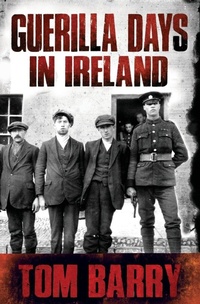
Guerilla Days in Ireland
Published on 5. May 2013
Book
Paperback/Softback
384 pages
978-1-78117-171-4 (ISBN)
Description
First published in 1949, 'Guerilla Days in Ireland' is an extraordinary story of the Irish War of Independence and the fight between two unequal forces, which ended in the withdrawal of the British from twenty-six counties. Seven weeks before the Truce of July 1921, the British presence in County Cork consisted of a total of over 12,500 men. Against these British forces stood the Irish Republican Army whose flying columns never exceeded 310 riflemen in the whole of the county. These flying columns were small groups of dedicated Volunteers, severely commanded and disciplined. Constantly on the move, their paramount objective was merely to exist, to strike when conditions were favourable and to avoid disaster at all costs. In 'Guerilla Days in Ireland' Tom Barry describes the setting up of the West Cork flying column, its training and the plan of campaign, which he implemented. In particular he gives his account of the Kilmichael ambush, one of the most controversial episodes of the War of Independence.
Reviews / Votes
Admired by Che Guevara, feared by the British Army, loved by the people he led.Tom Barry, legendary Commander of the West Cork Flying Column survived the War of Independence to tell his incredible story.
Guerilla Days in Ireland is Barry's compelling first-hand account of the struggle for independence in County Cork, the Rebel County.
Barry led a volunteer army in a victorious hide-and-seek campaign of Guerilla warfare matching wits against an enemy of overwhelming strength and power.
"Seven weeks before the truce to the Anglo-Irish War of July, 1921, the British presence in County Cork consisted of 8,800 front line infantry troops, 1,150 Black & Tan soldiers, 540 Auxiliaries, 2,080 machine gun corps, artillery and other units -- a total of over 12,500 men. Against these British forces stood the Irish Republican Army whose "Flying Columns" never exceeded 310 riflemen in the whole of County Cork. Men, moreover, with "no experience of war. . . untrained in the use of arms. . . with no tactical training. . . practically unarmed. . . ". These "flying columns" were small groups of dedicated volunteers, severely commanded and disciplined. Constantly on the move, their paramount objective was merely to exist; to strike when conditions were favourable, to avoid a disaster at all costs. In Guerilla Days in Ireland: A Personal Account of the Anglo-Irish War, which has been one of the classics of the Anglo-Irish War since its first publication in 1949, Tom Barry describes the setting up of the West Cork Flying Column, its training, and its plan of campaign. Guerilla Days in Ireland is the extraordinary story of the fight between two unequal forces, which ended in the withdrawal of the British from twenty-six counties. In particular, it is the story of the West Cork Flying Column under Tom Barry, a commander of genius and a national hero."
More details
Edition
New edition
Language
English
Place of publication
Cork
Ireland
Edition type
New edition
Illustrations
20 Illustrations, black and white
Dimensions
Height: 213 mm
Width: 140 mm
Thickness: 24 mm
Weight
546 gr
ISBN-13
978-1-78117-171-4 (9781781171714)
Copyright in bibliographic data and cover images is held by Nielsen Book Services Limited or by the publishers or by their respective licensors: all rights reserved.
Schweitzer Classification
Other editions
Additional editions
Previous edition

Tom Barry
Guerilla Days In Ireland
Book
01/1981
Anvil Books (Childrens Press)
€38.56
Article exhausted; check for reprint
Person
Tom Barry was born in 1898. In June 1915 he joined the British Army, not to secure home rule for Ireland or to fight for Irish freedom or for freedom of small nations - just to see what war was like. While fighting in Mesopotamia he heard of the 1916 Rising taking place at home. After the war he returned home and with some difficulty persuaded the IRA to trust him and to make use of his military experience. In the summer of 1920 he became training officer to the Third (West) Cork Brigade. Tom Barry fought on the republican side of the Civil War, was imprisoned and escaped. In the late 1930s he was Chief of Staff of the IRA. He died in 1980.