

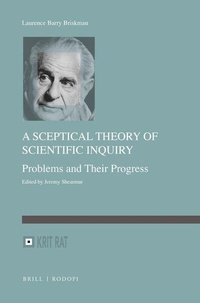
A Sceptical Theory of Scientific Inquiry: Problems and Their Progress
Published on 4. June 2020
Book
Hardback
234 pages
978-90-04-42919-2 (ISBN)
Description
A Sceptical Theory of Scientific Inquiry: Problems and Their Progress presents a distinctive re-interpretation of Popper's 'critical rationalism', displaying the kind of spirit found at the L.S.E. before Popper's retirement. It offers an alternative to interpretations of critical rationalism which have emphasised the significance of research programmes or metaphysics (Lakatos; Nicholas Maxwell), and is closer to the approach of Jagdish Hattiangadi. Briskman gives priority to methodological argument rather than logical formalisms, and takes further his own work on creativity. In addition to offering an important contribution to the understanding of critical rationalism, the book contains interesting engagements with Michael Polanyi and the Meno Paradox. This volume also contains an introduction by the editor, which situates Briskman's work in the history of the interpretation of 'critical rationalism'.
More details
Series
Language
English
Place of publication
Leiden
Netherlands
Target group
Professional and scholarly
Product notice
sewn/stitched
Cloth over boards
Dimensions
Height: 231 mm
Width: 155 mm
Thickness: 18 mm
Weight
476 gr
ISBN-13
978-90-04-42919-2 (9789004429192)
Copyright in bibliographic data and cover images is held by Nielsen Book Services Limited or by the publishers or by their respective licensors: all rights reserved.
Schweitzer Classification
Persons
Laurence Barry Briskman, Ph.D. 1983, University of Edinburgh, taught Philosophy at the University of Edinburgh up until 1993. He passed away in 2002.
Jeremy Shearmur, Ph.D. 1986, London School of Economics and Political Science, taught Philosophy at Edinburgh, Political Theory at Manchester, and was Lecturer, then Reader, in Political Theory and Philosophy at the Australian National University; currently he is Emeritus Fellow at the Australian National University.
Jeremy Shearmur, Ph.D. 1986, London School of Economics and Political Science, taught Philosophy at Edinburgh, Political Theory at Manchester, and was Lecturer, then Reader, in Political Theory and Philosophy at the Australian National University; currently he is Emeritus Fellow at the Australian National University.
Content
?Editorial Note
?Editorial Introduction
?Larry Briskman: Biographical Note
?Larry Briskman's Publications
?Guide to Abbreviations
?Acknowledgements
?Introduction: Two Types of Evolution
?1 The Rationality of Science
??1.1 The 'Initial' and 'Transcendental' Strategies
??1.2 Philosophy as Explication: Critical Remarks
??1.3 Methodology - Normative or Naturalistic?
??1.4 The Two Strategies and the Naturalistic Approach
??1.5 Conclusion
?2 Scientific Method and Scientific Progress
??2.1 The Problem of the Justification of a Method (or, The Generalised Problem of Induction)
??2.2 The Generalised Problem of Induction and Popper's Theory of Method
??2.3 Three Apparent Objections to (PR")
??2.4 'Transcendentalism' and Naturalism Re-visited
??2.5 The Relation of Rationality to Choice
??2.6 A Summary of the Argument So Far
??2.7 Explaining the Success of Science
??2.8 The Method of Strengthening Demands - Further Remarks
??2.9 Conclusion
?3 Methodology and the Context of Inquiry
??3.1 The Context of Discovery and the Context of Justification
??3.2 Three Crucial Distinctions
??3.3 Towards a Non-psychologistic Context of Production (I)
??3.4 Towards a Non-psychologistic Context of Production (II)
??3.5 Conclusion - Methodology as the Theory of Rational Inquiry
?4 Articulating Our Ignorance - Hopeful Scepticism and the Meno Paradox
??4.1 Some 'Popperian' Preliminaries
??4.2 Justificationism and the Problem of Diversity
??4.3 Justificationism, Scepticism, and Relativism
??4.4 Justificationism, Socratic Scepticism, and the Meno Paradox
??4.5 TDSK - A Socratic Sceptical Solution to the Meno Paradox
??4.6 Conclusion
?5 Against 'tacit knowing'
??5.1 Three Questions Concerning
??5.2 Against: 'Tacit Knowing'
??5.3 Conclusion
?6 Beyond TDSK
??6.1 The Kuhnian Objection
??6.2 The Problem of Content
??6.3 A Plausibility Argument for (D4)
??6.4 Beyond TDSK 2
?Bibliography
?Index of Names
?Index of Subjects XX
?Editorial Introduction
?Larry Briskman: Biographical Note
?Larry Briskman's Publications
?Guide to Abbreviations
?Acknowledgements
?Introduction: Two Types of Evolution
?1 The Rationality of Science
??1.1 The 'Initial' and 'Transcendental' Strategies
??1.2 Philosophy as Explication: Critical Remarks
??1.3 Methodology - Normative or Naturalistic?
??1.4 The Two Strategies and the Naturalistic Approach
??1.5 Conclusion
?2 Scientific Method and Scientific Progress
??2.1 The Problem of the Justification of a Method (or, The Generalised Problem of Induction)
??2.2 The Generalised Problem of Induction and Popper's Theory of Method
??2.3 Three Apparent Objections to (PR")
??2.4 'Transcendentalism' and Naturalism Re-visited
??2.5 The Relation of Rationality to Choice
??2.6 A Summary of the Argument So Far
??2.7 Explaining the Success of Science
??2.8 The Method of Strengthening Demands - Further Remarks
??2.9 Conclusion
?3 Methodology and the Context of Inquiry
??3.1 The Context of Discovery and the Context of Justification
??3.2 Three Crucial Distinctions
??3.3 Towards a Non-psychologistic Context of Production (I)
??3.4 Towards a Non-psychologistic Context of Production (II)
??3.5 Conclusion - Methodology as the Theory of Rational Inquiry
?4 Articulating Our Ignorance - Hopeful Scepticism and the Meno Paradox
??4.1 Some 'Popperian' Preliminaries
??4.2 Justificationism and the Problem of Diversity
??4.3 Justificationism, Scepticism, and Relativism
??4.4 Justificationism, Socratic Scepticism, and the Meno Paradox
??4.5 TDSK - A Socratic Sceptical Solution to the Meno Paradox
??4.6 Conclusion
?5 Against 'tacit knowing'
??5.1 Three Questions Concerning
??5.2 Against: 'Tacit Knowing'
??5.3 Conclusion
?6 Beyond TDSK
??6.1 The Kuhnian Objection
??6.2 The Problem of Content
??6.3 A Plausibility Argument for (D4)
??6.4 Beyond TDSK 2
?Bibliography
?Index of Names
?Index of Subjects XX