

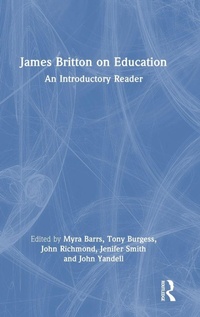
James Britton on Education
An Introductory Reader
1st Edition
Published on 27. December 2024
Book
Hardback
216 pages
978-1-032-87486-9 (ISBN)
Description
James Britton's work addresses central educational questions that are as relevant today as they were half a century ago. Britton was the architect of a theory of language and learning which has influenced the thinking and practice of generations of teachers across the anglophone world. This Reader helps teachers and students explore his theories of the relationships between language and thought, between thinking and feeling, the links between unconscious and conscious ways of knowing, and the symbolising nature of language.
This carefully curated collection of Britton's key writings renders his work accessible to today's students, educators and researchers. Fully annotated chapters explore how his work fuses observation and theory in a remarkable synthesis, and demonstrates the continuities between the early use of language and later, more complex achievements in speaking, listening, reading and writing.
All those involved in teacher education and training, including researchers and scholars, will find this a rich and insightful text.
This carefully curated collection of Britton's key writings renders his work accessible to today's students, educators and researchers. Fully annotated chapters explore how his work fuses observation and theory in a remarkable synthesis, and demonstrates the continuities between the early use of language and later, more complex achievements in speaking, listening, reading and writing.
All those involved in teacher education and training, including researchers and scholars, will find this a rich and insightful text.
Reviews / Votes
James Britton on Education: an Introductory Reader complements the pair of recent volumes, also published by Routledge, which reintroduce for practitioners the work of Lev Vygotsky and which are edited by two of the editors of this volume ... The reader shines a light on the historicity of the subject English and opens the road to a pedagogic heritage that trusts imaginative lesson-planning, licenses creative teaching and urges practitioners to reflect seriously on the essentials of practice: principles; relationships; temporality; assessment as against testing; the affective and aesthetic dimensions of learning as well as that of propositional knowledge; and the importance of a teacher who listens.- Patrick Yarke, Forum
More details
Language
English
Place of publication
London
United Kingdom
Publishing group
Taylor & Francis Ltd
Target group
College/higher education
Professional and scholarly
Undergraduate Advanced
Illustrations
4 s/w Abbildungen, 4 s/w Zeichnungen
4 Line drawings, black and white; 4 Illustrations, black and white
Dimensions
Height: 240 mm
Width: 161 mm
Thickness: 17 mm
Weight
514 gr
ISBN-13
978-1-032-87486-9 (9781032874869)
Copyright in bibliographic data and cover images is held by Nielsen Book Services Limited or by the publishers or by their respective licensors: all rights reserved.
Schweitzer Classification
Other editions
Additional editions
E-Book
12/2024
1st Edition
Routledge
€40.99
Available for download
E-Book
12/2024
1st Edition
Routledge
€40.99
Available for download
Book
12/2024
1st Edition
Routledge
€46.20
Shipment within 10-20 days
Persons
Myra Barrs was Honorary Senior Research Associate at the UCL Institute of Education, UK, and former director of the Centre for Literacy in Primary Education.
Tony Burgess has been a secondary-school teacher, before working in research and teacher education at the UCL Institute of Education, UK.
John Richmond has been an English teacher, an adviser of teachers and an educational broadcaster.
Jenifer Smith has been an English and drama teacher in both primary and secondary schools, before becoming a teacher educator at the University of East Anglia, UK.
John Yandell taught in secondary schools for 20 years before moving to the UCL Institute of Education, UK, where he is Professor of English in Education.
Tony Burgess has been a secondary-school teacher, before working in research and teacher education at the UCL Institute of Education, UK.
John Richmond has been an English teacher, an adviser of teachers and an educational broadcaster.
Jenifer Smith has been an English and drama teacher in both primary and secondary schools, before becoming a teacher educator at the University of East Anglia, UK.
John Yandell taught in secondary schools for 20 years before moving to the UCL Institute of Education, UK, where he is Professor of English in Education.
Content
Introduction - James Britton's life and work
Section 1 The language of young children
1.1 The development of language: 'Learning to speak'
1.2 Early literacy: 'Young fluent writers'
1.3 Meaning-making, interaction and play: 'The anatomy of human experience - the role of inner speech'
Section 2 Language and learning at school
2.1 The value of talk: 'Now that you go to school'
2.2 'Language and learning'
2.3 In defence of 'progressive' practice: 'Language in the British primary school'
2.4 The disorderliness of learning: from 'Talking to learn'
Section 3 Writing
3.1 Expressive writing: 'Writing to learn and learning to write'
3.2 Functions and audiences in the development of writing: from The development of writing abilities (11-18)
3.3 What writers have in common: 'Shaping at the point of utterance'
Section 4 Teachers and research
4.1 'A note on teaching, research and "development"'
4.2. 'A quiet form of research'
4.3 The community of the classroom: 'Vygotsky's contribution to pedagogical theory'
Section 5 A certain idea of English
5.1 The scope of English: 'What is English?'
5.2 'Literature in its place'
5.3 Autobiographical coda: 'English teaching: retrospect and prospect'
5.4 Today's student teachers reading and discussing Britton
Section 1 The language of young children
1.1 The development of language: 'Learning to speak'
1.2 Early literacy: 'Young fluent writers'
1.3 Meaning-making, interaction and play: 'The anatomy of human experience - the role of inner speech'
Section 2 Language and learning at school
2.1 The value of talk: 'Now that you go to school'
2.2 'Language and learning'
2.3 In defence of 'progressive' practice: 'Language in the British primary school'
2.4 The disorderliness of learning: from 'Talking to learn'
Section 3 Writing
3.1 Expressive writing: 'Writing to learn and learning to write'
3.2 Functions and audiences in the development of writing: from The development of writing abilities (11-18)
3.3 What writers have in common: 'Shaping at the point of utterance'
Section 4 Teachers and research
4.1 'A note on teaching, research and "development"'
4.2. 'A quiet form of research'
4.3 The community of the classroom: 'Vygotsky's contribution to pedagogical theory'
Section 5 A certain idea of English
5.1 The scope of English: 'What is English?'
5.2 'Literature in its place'
5.3 Autobiographical coda: 'English teaching: retrospect and prospect'
5.4 Today's student teachers reading and discussing Britton