

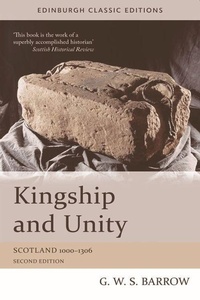
Kingship and Unity
Scotland 1000-1306
2nd Edition
Published on 13. April 2015
Book
Paperback/Softback
224 pages
978-1-4744-0181-4 (ISBN)
Description
A stunning overview of the medieval landscape of Scotland
This is a history of the forging of the Scottish kingdom during the first three centuries of the second millennium. In AD 1000 the Scottish kings had embarked on the annexation of English-speaking Lothian and of Cumbric-speaking Clydesdale, Ayrshire and Dumfriesshire. The country's enlargement continued under a line of remarkably able kings with the inclusion first of the highlands and then, after the defeat of the Norwegians in 1263, of the islands of the Inner and Outer Hebrides. How Scotland's landscape influenced its people and conditioned its outlook on the world is a theme running throughout the book.
Geoffrey Barrow describes the evolution of Scottish kingship and government during the period, in the process examining the character of Scottish feudalism and the manner of its imposition. He discusses the social, economic and political changes of the period, with separate chapters on the expansion of towns and trade, the role of the church, and advances in education and learning. A sense of national identity had, he argues, become sufficiently strong by the end of the thirteenth century for the country to survive humiliation by Edward I and to reunite under Robert Bruce. With Bruce's coronation as Robert I in 1306 this richly detailed and readable account of Scotland's formative period comes to an end.
Since first publication in 1981, this reissued edition for The Edinburgh Classic Editions series, as indicated in the preface by the series editor Jenny Wormald, can now rightly take its place amongst the classics of Scottish history.
Key features:
Long seen as a key text for students of medieval ScotlandWritten by a respected and renowned historianReadable, cinematic in scope, colourful and scholarly at the same time
This is a history of the forging of the Scottish kingdom during the first three centuries of the second millennium. In AD 1000 the Scottish kings had embarked on the annexation of English-speaking Lothian and of Cumbric-speaking Clydesdale, Ayrshire and Dumfriesshire. The country's enlargement continued under a line of remarkably able kings with the inclusion first of the highlands and then, after the defeat of the Norwegians in 1263, of the islands of the Inner and Outer Hebrides. How Scotland's landscape influenced its people and conditioned its outlook on the world is a theme running throughout the book.
Geoffrey Barrow describes the evolution of Scottish kingship and government during the period, in the process examining the character of Scottish feudalism and the manner of its imposition. He discusses the social, economic and political changes of the period, with separate chapters on the expansion of towns and trade, the role of the church, and advances in education and learning. A sense of national identity had, he argues, become sufficiently strong by the end of the thirteenth century for the country to survive humiliation by Edward I and to reunite under Robert Bruce. With Bruce's coronation as Robert I in 1306 this richly detailed and readable account of Scotland's formative period comes to an end.
Since first publication in 1981, this reissued edition for The Edinburgh Classic Editions series, as indicated in the preface by the series editor Jenny Wormald, can now rightly take its place amongst the classics of Scottish history.
Key features:
Long seen as a key text for students of medieval ScotlandWritten by a respected and renowned historianReadable, cinematic in scope, colourful and scholarly at the same time
Reviews / Votes
Kingship and Unity is not only a perceptive and accomplished book, but it is also written in an accessible and engaging manner. This revised edition remains the authoritative account of the shaping of Scotland during the High Middle Ages and of the kingdom's place in the British Isles and Europe. * Katie Stevenson, University of St Andrews *More details
Series
Edition
2nd edition
Language
English
Place of publication
Edinburgh
United Kingdom
Target group
Professional and scholarly
Edition type
New edition
Product notice
Paperback (trade)
Unsewn / adhesive bound
Dimensions
Height: 213 mm
Width: 137 mm
Thickness: 15 mm
Weight
340 gr
ISBN-13
978-1-4744-0181-4 (9781474401814)
Copyright in bibliographic data and cover images is held by Nielsen Book Services Limited or by the publishers or by their respective licensors: all rights reserved.
Schweitzer Classification
Other editions
Additional editions
E-Book
04/2015
1st Edition
Edinburgh University Press
€24.49
Available for download
E-Book
04/2015
1st Edition
Edinburgh University Press
€0.00
Available for download
Person
G. W. S. Barrow was Sir William Fraser Professor of Scottish History and Palaeography, University of Edinburgh, 1979-92. His books include FeudalBritain (London, 1956); Robert Bruce and the Community of the Realm of Scotland (4th edition, Edinburgh, 2005); The Anglo-Norman Era in ScottishHistory (Oxford, 1980 - his Ford lectures); Scotland and its Neighbours in the Middle Ages (London, 1992); and The Kingdom of the Scots (2nd edition,Edinburgh, 2003).
Content
Genealogy of the Royal House; Part One; 1. Land and People; 2. Kings and Kingship; 3. The Feudal Settlement; 4. The Church Transformed; 5. Education and Learning; 6. Burghs and Burgesses; Part Two; 7. The Winning of the West; 8. Communities of the Realm; 9. Scotland in Europe; A Note on Measures and Money; Glossary of Unfamiliar Words; Chronology; Further Reading; Index; Map I: Scotland in 1286; Map II: The Church in the Twelfth and Thirteenth Centuries.