

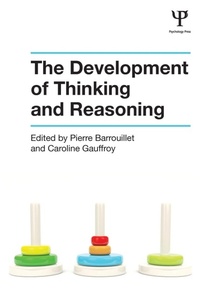
The Development of Thinking and Reasoning
1st Edition
Published on 28. February 2013
Book
Paperback/Softback
264 pages
978-1-84872-132-6 (ISBN)
Description
Thinking and reasoning are key activities for human beings. In this book a distinguished set of contributors provides a wide readership with up-to-date scientific advances in the developmental psychology of thinking and reasoning, both at the theoretical and empirical levels.
The first part of the book illustrates how modern approaches to the study of thinking and reasoning have gone beyond the Piagetian legacy: through the investigation of avenues previously not explored, and by demonstrating that young children have higher capacities than was assumed within the Piagetian tradition. The second part focuses upon theoretical and empirical investigations of the interplay between logic and intuition in reasoning and decision making, and how these forms of thinking evolve with age, through the general framework of what is known as dual-process theories. Contrary to Piaget's claim, it becomes apparent that elaborate adult reasoning could rely on some form of intuition.
The Development of Thinking and Reasoning provides psychologists, educators and everyone interested in child development with an integrated and up-to-date series of chapters, written by prominent specialists in the areas of thinking, reasoning, and decision making.
The first part of the book illustrates how modern approaches to the study of thinking and reasoning have gone beyond the Piagetian legacy: through the investigation of avenues previously not explored, and by demonstrating that young children have higher capacities than was assumed within the Piagetian tradition. The second part focuses upon theoretical and empirical investigations of the interplay between logic and intuition in reasoning and decision making, and how these forms of thinking evolve with age, through the general framework of what is known as dual-process theories. Contrary to Piaget's claim, it becomes apparent that elaborate adult reasoning could rely on some form of intuition.
The Development of Thinking and Reasoning provides psychologists, educators and everyone interested in child development with an integrated and up-to-date series of chapters, written by prominent specialists in the areas of thinking, reasoning, and decision making.
Reviews / Votes
How do human thinkers interact with reasoning norms? The Development of Thinking and Reasoning is a timely and impressive answer based on post-Piagetian and dual-process theories. Its central themes include children's surprising capabilities, adults' unexpected liabilities to error, interplays between heuristic and rule-based inferences. The promise is inviting: understanding rationality requires a developmental focus. - Leslie Smith, Lancaster University, UKDevelopmental science owes much to Piaget, but the domain has also evolved considerably since his time. The Development of Thinking and Reasoning provides a scholarly contemporary survey of one major branch of developmental research. Beyond introducing readers to current thinking in the field, however, this book serves another important purpose - drawing out connections across epochs and between schools of thought while also sharpening the differences between them. Students and scholars alike will find it a valuable contribution to the developmental literature. - Michael W. Connell, Institute for Knowledge Design, Massachusetts, USA This work does an excellent job of reinforcing the aphorism attributed to Einstein that understanding physics is child's play compared to understand child's play. Summing Up: Recommended.- B.C. Beins, Ithaca College, for CHOICE, November 2013.
How do human thinkers interact with reasoning norms? The Development of Thinking and Reasoning is a timely and impressive answer based on post-Piagetian and dual-process theories. Its central themes include children's surprising capabilities, adults' unexpected liabilities to error, interplays between heuristic and rule-based inferences. The promise is inviting: understanding rationality requires a developmental focus. - Leslie Smith, Lancaster University, UK
Developmental science owes much to Piaget, but the domain has also evolved considerably since his time. The Development of Thinking and Reasoning provides a scholarly contemporary survey of one major branch of developmental research. Beyond introducing readers to current thinking in the field, however, this book serves another important purpose - drawing out connections across epochs and between schools of thought while also sharpening the differences between them. Students and scholars alike will find it a valuable contribution to the developmental literature. - Michael W. Connell, Institute for Knowledge Design, Massachusetts, USA
More details
Language
English
Place of publication
Hove
United Kingdom
Publishing group
Taylor & Francis Ltd
Target group
College/higher education
Illustrations
21 s/w Abbildungen, 2 s/w Tabellen
2 Tables, black and white; 21 Illustrations, black and white
Dimensions
Height: 234 mm
Width: 156 mm
Thickness: 14 mm
Weight
404 gr
ISBN-13
978-1-84872-132-6 (9781848721326)
Copyright in bibliographic data and cover images is held by Nielsen Book Services Limited or by the publishers or by their respective licensors: all rights reserved.
Schweitzer Classification
Other editions
Additional editions
Pierre Barrouillet | Caroline Gauffroy
The Development of Thinking and Reasoning
E-Book
06/2013
1st Edition
Psychology Press Ltd
€72.49
Available for download
Pierre Barrouillet | Caroline Gauffroy
The Development of Thinking and Reasoning
E-Book
06/2013
1st Edition
Psychology Press Ltd
€72.49
Available for download
Pierre Barrouillet | Caroline Gauffroy
The Development of Thinking and Reasoning
Book
02/2013
1st Edition
Psychology Press Ltd
€262.20
Shipment within 3-4 weeks
Persons
Pierre Barrouillet is Professor of Developmental Psychology at the University of Geneva, and Director of the Archives Jean Piaget. His research investigates the development of numerical cognition, conditional reasoning, as well as the functioning and development of working memory.
Caroline Gauffroy is a postdoctoral assistant at the University of Geneva. Her main research interests concern conditional reasoning, propositional reasoning and development.
Caroline Gauffroy is a postdoctoral assistant at the University of Geneva. Her main research interests concern conditional reasoning, propositional reasoning and development.
Content
Pierre Barrouillet & Caroline Gauffroy Introduction: From Piaget to Dual-Process Theories: The Complexities of Thinking and Reasoning Development. PART 1: Thinking and Reasoning: Beyond Piaget's Conceptions. David Moshman Epistemic Cognition and Development. Julie E. Meehan & Ruth M.J. Byrne The Development of the Rational Imagination: How Children Create Counterfactual Alternatives to Reality. Usha Goswami The Development of Reasoning by Analogy. Henry Markovits The Development of Abstract Conditional Reasoning. PART 2: Dual-Processes Approaches. Pierre Barrouillet & Caroline Gauffroy Dual Processes and Mental Models in the Development of Conditional Reasoning. Kinga Morsanyi & Simon J. Handley Heuristics and Biases - Insights from Developmental Studies. Paul Klackzynski Culture and Developments in Heuristics and Biases from Preschool through Adolescence: Challenges and Implications for Social development. Valerie F. Reyna Intuition, Reasoning and Development: A Fuzzy-Trace Theory. Carlos F. Gomes & Charles J. Brainerd Dual Processes in the Development of Reasoning: The Memory Side of the Theory.