

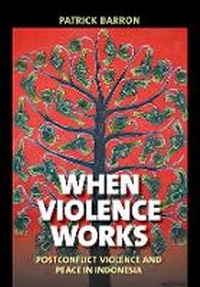
When Violence Works
Postconflict Violence and Peace in Indonesia
Published on 15. April 2019
Book
Hardback
300 pages
978-1-5017-3544-8 (ISBN)
Description
Why are some places successful in moving from war to consolidated peace while others continue to be troubled by violence? And why does postconflict violence take different forms and have different intensities? By developing a new theory of postconflict violence Patrick Barron's When Violence Works makes a significant contribution to our understanding.
Barron picks out three postconflict regions in Indonesia in which to analyze what happens once the "official" fighting ends: North Maluku has seen peace consolidated; Maluku still witnesses large episodes of violence; and Aceh experiences continuing occurrences of violence but on a smaller scale than in Maluku. He argues that violence after war has ended (revenge killings, sexual violence, gang battles, and violent crime, in addition to overtly political conflict) is not the result of failed elite bargains or weak states, but occurs because the actors involved see it as beneficial and lowcost. His findings pertain directly to Indonesia, but the theory will have relevance far beyond as those studying countries such as Colombia, the Philippines, Iraq, Afghanistan, and Syria seek a framework in which to assess what happens after war ends. Barron's theory also provides practical guidance for policymakers and development practitioners. Ultimately, When Violence Works pushes forward our understanding of why postconflict violence occurs and takes the forms it does.
Barron picks out three postconflict regions in Indonesia in which to analyze what happens once the "official" fighting ends: North Maluku has seen peace consolidated; Maluku still witnesses large episodes of violence; and Aceh experiences continuing occurrences of violence but on a smaller scale than in Maluku. He argues that violence after war has ended (revenge killings, sexual violence, gang battles, and violent crime, in addition to overtly political conflict) is not the result of failed elite bargains or weak states, but occurs because the actors involved see it as beneficial and lowcost. His findings pertain directly to Indonesia, but the theory will have relevance far beyond as those studying countries such as Colombia, the Philippines, Iraq, Afghanistan, and Syria seek a framework in which to assess what happens after war ends. Barron's theory also provides practical guidance for policymakers and development practitioners. Ultimately, When Violence Works pushes forward our understanding of why postconflict violence occurs and takes the forms it does.
Reviews / Votes
Judging from the informative stories that Barron uses to illustrate his analysis, primal hatreds still fuel conflict and do not yield easily to institutional fixes.(Foreign Affairs) This is the first comprehensive book on post-conflict violence in Indonesia...The title perfectly tells what the book does. Barron eloquently explains when violence works by systematically identifying two local actors (local violence specialists and local politicians) and their involvements in violence. The book explains why, how and in what circumstances different scales of post-conflict violence emerge.
- MOHAMMAD ZULFAN TADJOEDDIN, Western Sydney University, Australia (PACIFIC AFFAIRS)
More details
Language
English
Place of publication
Ithaca
United States
Target group
College/higher education
Product notice
Paper over boards
Illustrations
3 b&w line drawings, 1 map, 4 graphs - 4 Graphs - 3 Line drawings, black and white - 1 Maps
Dimensions
Height: 229 mm
Width: 152 mm
Thickness: 27 mm
Weight
907 gr
ISBN-13
978-1-5017-3544-8 (9781501735448)
Copyright in bibliographic data and cover images is held by Nielsen Book Services Limited or by the publishers or by their respective licensors: all rights reserved.
Schweitzer Classification
Other editions
Additional editions
E-Book
04/2019
Cornell University Press
€41.99
Available for download
E-Book
04/2019
1st Edition
Cornell University Press
€162.99
Available for download
Person
Patrick Barron is Regional Advisor for the World Bank. He previously served as Regional Director at The Asia Foundation and led the World Bank's conflict programming in Indonesia for seven years. He is coauthor of the award-winning Contesting Development and has written for World Development, Journal of Political Economy, and Journal of East Asian Studies.
Content
List of Tables and Figures
Preface
Introduction
1. Studying Postconflict Violence: Approaches and Methods
2. Explaining Postconflict Violence: Evidence, Theories, and Arguments
3. Violence and Indonesia's Democratic Transition
4. Large Episodic Violence in Postconflict Maluku
5. North Maluku's Peace
6. Small Episodic Violence in Postconflict Aceh
7. Why Has Extended Violent Conflict Not Recurred?
Conclusions
Glossary
Appendix. The National Violence Monitoring System Dataset
Notes
References
Index
Preface
Introduction
1. Studying Postconflict Violence: Approaches and Methods
2. Explaining Postconflict Violence: Evidence, Theories, and Arguments
3. Violence and Indonesia's Democratic Transition
4. Large Episodic Violence in Postconflict Maluku
5. North Maluku's Peace
6. Small Episodic Violence in Postconflict Aceh
7. Why Has Extended Violent Conflict Not Recurred?
Conclusions
Glossary
Appendix. The National Violence Monitoring System Dataset
Notes
References
Index