

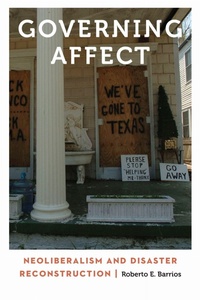
Governing Affect
Neoliberalism and Disaster Reconstruction
Published on 1. May 2017
Book
Paperback/Softback
306 pages
978-1-4962-0190-4 (ISBN)
Description
Roberto E. Barrios presents an ethnographic study of the aftermaths of four natural disasters: southern Honduras after Hurricane Mitch; New Orleans following Hurricane Katrina; Chiapas, Mexico, after the Grijalva River landslide; and southern Illinois following the Mississippi River flood. Focusing on the role of affect, Barrios examines the ways in which people who live through disasters use emotions as a means of assessing the relevance of governmentally sanctioned recovery plans, judging the effectiveness of such programs, and reflecting on the risk of living in areas that have been deemed prone to disaster. Emotions such as terror, disgust, or sentimental attachment to place all shape the meanings we assign to disasters as well as our political responses to them.
The ethnographic cases in Governing Affect highlight how reconstruction programs, government agencies, and recovery experts often view postdisaster contexts as opportune moments to transform disaster-affected communities through principles and practices of modernist and neoliberal development. Governing Affect brings policy and politics into dialogue with human emotion to provide researchers and practitioners with an analytical toolkit for apprehending and addressing issues of difference, voice, and inequity in the aftermath of catastrophes.
The ethnographic cases in Governing Affect highlight how reconstruction programs, government agencies, and recovery experts often view postdisaster contexts as opportune moments to transform disaster-affected communities through principles and practices of modernist and neoliberal development. Governing Affect brings policy and politics into dialogue with human emotion to provide researchers and practitioners with an analytical toolkit for apprehending and addressing issues of difference, voice, and inequity in the aftermath of catastrophes.
Reviews / Votes
"Seamlessly weaving together poststructural theory, political economy, ethnography, and personal narrative, Roberto Barrios opens new terrain for understanding why disaster reconstruction so often falls short in addressing the needs of disaster victims by failing to recognize the power of affect."-Anthony Oliver-Smith, author of The Martyred City: Death and Rebirth in the Andes"A major contribution to disaster scholarship . . . [and] provocative enough to provide an interesting classroom debate."-William L. Waugh Jr., coeditor of Emergency Management: Principles and Practice for Local Government, 2nd edition
"In crystal clear, step-by-step prose, illuminated by four heart-wrenching examples, Roberto Barrios strips bare the ways pre- and postdisaster agencies and development schemes ignore the crucial importance of a vulnerable or devastated people's well-being."-Susanna M. Hoffman, coeditor of The Angry Earth: Disaster in Anthropological Perspective
More details
Series
Language
English
Place of publication
Lincoln
United States
Target group
Professional and scholarly
Product notice
Paperback (trade)
Illustrations
8 photographs, 2 illustrations, 10 maps, index
Dimensions
Height: 229 mm
Width: 152 mm
Thickness: 18 mm
Weight
449 gr
ISBN-13
978-1-4962-0190-4 (9781496201904)
Copyright in bibliographic data and cover images is held by Nielsen Book Services Limited or by the publishers or by their respective licensors: all rights reserved.
Schweitzer Classification
Other editions
Additional editions
E-Book
05/2017
1st Edition
University of Nebraska Press
€31.99
Available for download
E-Book
05/2017
1st Edition
University of Nebraska Press
€36.99
Available for download
Person
Roberto E. Barrios is an associate professor of anthropology at Southern Illinois University in Carbondale.
Content
List of Illustrations Acknowledgments Author's Note Introduction: Affect and Emotions in Disaster Reconstruction 1. Powerful Feelings: Emotions and Governmentality in Disaster Research 2. Hallarse: Defining Recovery in Affective Terms 3. Feelings of Inequity: Gender and the Postcolonial Modernity of Disaster Reconstruction 4. The Marero: Terror and Disgust in the Aftermath of Mitch 5. Ecologies of Affect and Affective Regimes: The Neoliberal Reconstruction of New Orleans 6. How to Care? The Contested Affects of Disaster Recovery in the Lower Ninth Ward 7. Criollos, Creoles, and the Mobile Taquerias: Latinophobia in Post-Katrina New Orleans 8. To Love a Small Town: The Political Ecology of Affect in the Middle Mississippi 9. Rebuilding It Better: The Ethical Challenges of Disaster Recovery 10. The Anthropology of Affect and Disasters: From Critique to Practice References Index