

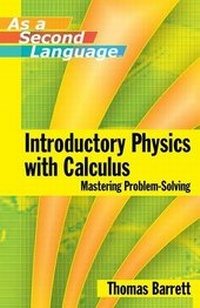
University Physics As a Second Language
Mastering Problem Solving
Published on 11. November 2005
Book
Paperback/Softback
272 pages
978-0-471-73910-4 (ISBN)
Description
Get a better grade in Physics
Solving physics problems can be challenging at times. But with hard work and the right study tools, you can learn the language of physics and get the grade you want. With Tom Barrett's University Physics as a Second Language(TM): Mastering Problem Solving, you'll be able to better understand fundamental physics concepts, solve a variety of problems, and focus on what you need to know to succeed.
Here's how you can get a better grade in physics:
Understand the basic concepts
University Physics as a Second Language(TM) focuses on selected topics in calculus-based physics to give you a solid foundation. Tom Barrett explains these topics in clear, easy-to-understand language.
Break problems down into simple steps
University Physics as a Second Language(TM) teaches you to approach problems more efficiently and effectively. You'll learn how to recognize common patterns in physics problems, break problems down into manageable steps, and apply appropriate techniques.
The book takes you step-by-step through the solutions to numerous examples.
Improve your problem-solving skills
University Physics as a Second Language(TM) will help you develop the skills you need to solve a variety of problem types. You'll learn timesaving problem-solving strategies that will help you focus your efforts, as well as how to avoid potential pitfalls.
More details
Person
Tom Barrett is a lecturer at Ohio State University where he teaches calculus-based introductory physics.
Content
Preface. Chapter 1. How to Learn Physics.
1.1 The Deadly Sins.
1.2 The Cardinal Virtue.
1.3 Units.
Chapter 2. Constant Acceleration.
2.1 Acceleration and Velocity.
2.2 Constant Acceleration.
2.3 Vectors.
2.4 Projectiles.
Chapter 3. Forces.
3.1 Free Body Diagram.
3.2 Solving F = ma.
Chapter 4. Forces, the Sequel.
4.1 Friction Forces.
4.2 Circular Paths.
Chapter 5. Energy.
5.1 Energy and Work.
5.2 Potential Energy.
5.3 Using Conservation of Energy.
Chapter 6. Momentum.
6.1 Momentum and Impulse.
6.2 Momentum and Collisions.
6.3 Impulse and Force.
6.4 Elastic Collisions.
6.5 Using Conservation of Momentum.
Chapter 7. Rotation.
7.1 Constant Angular Acceleration.
7.2 Connecting Angular and Linear Motion.
7.3 Torque and Moment of Inertia.
7.4 Energy and Rolling Motion.
7.5 Angular Momentum and Angular Impulse.
7.6 Statics.
Chapter 8. Electric and Magnetic Fields.
8.1 Electric Forces.
8.2 Electric Fields.
8.3 Magnetic Forces.
8.4 Magnetic Fields.
9. Advanced Electric & Magnetic Fields.
9.1 Gaussa??s Law.
9.2 Amperea??s Law.
9.3 Induced Currents.
Chapter 10.Potential = Voltage.
10.1 Finding the Potential.
10.2 Using the Potential.
Chapter 11. Circuits.
11.1 Resistors and Capacitors.
11.2 Series and Parallel.
11.3 One-Battery Circuits.
11.4 Kirchhoffa??s Rules.
11.5 Mixed Circuits R-C and R-L.
1.1 The Deadly Sins.
1.2 The Cardinal Virtue.
1.3 Units.
Chapter 2. Constant Acceleration.
2.1 Acceleration and Velocity.
2.2 Constant Acceleration.
2.3 Vectors.
2.4 Projectiles.
Chapter 3. Forces.
3.1 Free Body Diagram.
3.2 Solving F = ma.
Chapter 4. Forces, the Sequel.
4.1 Friction Forces.
4.2 Circular Paths.
Chapter 5. Energy.
5.1 Energy and Work.
5.2 Potential Energy.
5.3 Using Conservation of Energy.
Chapter 6. Momentum.
6.1 Momentum and Impulse.
6.2 Momentum and Collisions.
6.3 Impulse and Force.
6.4 Elastic Collisions.
6.5 Using Conservation of Momentum.
Chapter 7. Rotation.
7.1 Constant Angular Acceleration.
7.2 Connecting Angular and Linear Motion.
7.3 Torque and Moment of Inertia.
7.4 Energy and Rolling Motion.
7.5 Angular Momentum and Angular Impulse.
7.6 Statics.
Chapter 8. Electric and Magnetic Fields.
8.1 Electric Forces.
8.2 Electric Fields.
8.3 Magnetic Forces.
8.4 Magnetic Fields.
9. Advanced Electric & Magnetic Fields.
9.1 Gaussa??s Law.
9.2 Amperea??s Law.
9.3 Induced Currents.
Chapter 10.Potential = Voltage.
10.1 Finding the Potential.
10.2 Using the Potential.
Chapter 11. Circuits.
11.1 Resistors and Capacitors.
11.2 Series and Parallel.
11.3 One-Battery Circuits.
11.4 Kirchhoffa??s Rules.
11.5 Mixed Circuits R-C and R-L.