

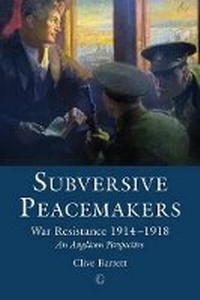
Subversive Peacemakers
War Resistance 1914-1918: An Anglican Perspective
Published on 30. October 2014
Book
Paperback/Softback
312 pages
978-0-7188-9367-5 (ISBN)
Description
The outbreak of the First World War saw an upsurge of patriotism. The Church generally saw the war as justified, and many clergy encouraged the men in their congregations to join the army. There was, however, already a strong strand of anti-war sentiment, opposed to the dominant theology of the Establishment. This was partly based on traditional Christian pacifism, but included other religious, social and political influences. Campaigners and conscientious objectors voiced a growing concern about the huge human cost of a conflict seemingly endlessly bogged down in the mud of the Flanders poppy fields. 'Subversive Peacemakers' recounts the stories of a strong and increasingly organised opposition to war, from peace groups to poets, from preachers to politicians, from women to working men, all of whom struggled to secure peace in a militarised and fragmenting society. Clive Barrett demonstrates that the Church of England provided an unlikely setting for much of this war resistance.
Barrett masterfully narrates the story of the peace movement, bringing together stories of war-resistance until now lost, disregarded or undervalued. The people involved, as well as the dramatic events of the conflict themselves, are seen in a new light.
Barrett masterfully narrates the story of the peace movement, bringing together stories of war-resistance until now lost, disregarded or undervalued. The people involved, as well as the dramatic events of the conflict themselves, are seen in a new light.
Reviews / Votes
"Clive masterfully narrates the story of the peace movement, bringing together stories of war-resistance until now lost, disregarded or undervalued."The Anglican Peacemaker, vol 14, issue 2, (October 2014)
"This book recounts the stories of a strong and increasingly organised opposition to war, from peace groups to poets, from preachers to politicians, from women to working men, all of whom struggled to secure peace in a militarised and fragmenting society...Clive Barrett demonstrates that the Church of England provided an unlikely setting for much of this war resistance."
International Network of Museums for Peace Newsletter, No. 9, (November 2014)
"This is a remarkable book on an unanticipated subject [...]. One must admire the width of his research. The book has excellent end notes, bibliography and index. It should be a long standing reference."
Ian Simpson, Headingley Perish Magazine, March 2015
"[...]It is a vitally usefull addition to the literature on the subject. I have already drawn on it several times in my own teachings."
Symon Hill, Third Way, vol.39, no.2, March 2015
" Clive Barret in this well-documentated study Subversive Peacemakers reveals new material, especially bout the small number of anglican COs in the First World War"
Canon Alan Wilkinson, Church Times, 13th March 2015
"This is a thoroughly researched and carefully documented work to be recommended to any serious reader wanting to examine the history and significance of those who took a costly pacifist stand."
Rev. Marie Dove, Methodist Recorder, 1st May 2015
"I loved this book and learned such a lot from it, not least more details and new light on the history of [the Fellowship of Reconciliation] ... anybody interested in the history of the peace movement will be delighted with this new Anglican perspective of war resistance during the First World War. The style of writing and the way Dr Barrett has organised the book makes it very easy to read and here is an author unafraid to speak truth as much as were the people he writes about."
Geraldine Bridges, Peacelinks, March-May 2015
"Clive Barrett is ideally placed to document Anglican resistance to the First World War...A thoroughly-researched and often entertaining account of those subversive peacemakers."
Virginia Moffatt, Peace News, April-May 2015
"It is a masterful and passionately told story of war resistance previously disregarded or undervalued in the unlikely setting of the Church of England."
Cyril Pierce, Reviews in History, Review no. 1779, June 2015
"...deeply compelling..."
Peter M. Waddell, Reviews in Religion & Theology, 22:4, 2015
"Barrett's work is a good history of war resistance during the first World War that provides the reader with a thorough insight into the often hidden lives and opinions of those who could not, and would not, acquiesce in the general enthusiasm for the war's cause and its climate of national hatred."
Jan Marten Ivo Klaver, The Heythrop Journal, Volume 59, Issue 2, March 2018
More details
Language
English
Place of publication
Cambridge
United Kingdom
Publishing group
James Clarke & Co Ltd
Target group
College/higher education
Professional and scholarly
Dimensions
Height: 234 mm
Width: 156 mm
Weight
483 gr
ISBN-13
978-0-7188-9367-5 (9780718893675)
Copyright in bibliographic data and cover images is held by Nielsen Book Services Limited or by the publishers or by their respective licensors: all rights reserved.
Schweitzer Classification
Other editions
Additional editions
E-Book
10/2014
Lutterworth Press
€24.99
Available for download
E-Book
10/2014
Lutterworth Press
€18.49
Available for download
Person
Dr Clive Barrett is an Anglican priest, working with West Yorkshire Ecumenical Council to build relationships between churches of different traditions. He has edited volumes on ecumenism ('Unity in Process', 2012) and international peace heritage ('Museums for Peace: Transforming Cultures', 2012). A past Chair of the Anglican Pacifist Fellowship, he is Chair of the Peace Museum, Bradford, and a Visiting Research Fellow at the Department of Theology and Religious Studies, University of Leeds.
Content
Preface
Part 1. Setting the Scene
Chapter 1. Introduction
Chapter 2. An era ends and a new pacifism emerges
Part 2. Resisting War 1914-1918
Chapter 3. 1914 - A new peace movement
Chapter 4. The pen is mightier than the sword - George Lansbury
Chapter 5. Women for peace
Chapter 6. Clergy in the front line
Chapter 7. From India and the U.S. - Opponents of World War
Chapter 8. Conscience verses the military state
Chapter 9. The cost of resistance
Chapter 10. Losing 'The Manhood of England'
Part 3. Addressing the incompatible
Chapter 11. The aftermath of war
Chapter 12. Reflection on the legacy of 1914-1918 war resistance
Part 1. Setting the Scene
Chapter 1. Introduction
Chapter 2. An era ends and a new pacifism emerges
Part 2. Resisting War 1914-1918
Chapter 3. 1914 - A new peace movement
Chapter 4. The pen is mightier than the sword - George Lansbury
Chapter 5. Women for peace
Chapter 6. Clergy in the front line
Chapter 7. From India and the U.S. - Opponents of World War
Chapter 8. Conscience verses the military state
Chapter 9. The cost of resistance
Chapter 10. Losing 'The Manhood of England'
Part 3. Addressing the incompatible
Chapter 11. The aftermath of war
Chapter 12. Reflection on the legacy of 1914-1918 war resistance