

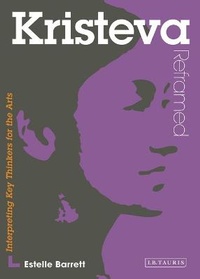
Kristeva Reframed
Interpreting Key Thinkers for the Arts
Published on 2. December 2010
Book
Paperback/Softback
184 pages
978-1-84511-660-6 (ISBN)
Description
For Kristeva, in a world immersed in readymade images, art or aesthetic experience is a practice that constitutes both a subject (a sense of self) and an object that is able to transform meaning and consciousness. 'Kristeva Reframed' examines key ideas in Kristeva's work to show how they are most relevant to artists, and how they can be applied in interpreting artworks. With examples from the paintings of Van Gogh and Picasso, the work of contemporary feminist painters, the photography of Bill Henson and the film and animation work of Van Sowerine, Estelle Barrett demonstrates how Kristeva can illuminate the relationships between artist and art object, between artists, artworks and audiences, and between art and knowledge. Through these relationships she explores what Kristeva's work reveals about the role and function of art in society and offers a smooth passage through Kristeva's ideas and her relevance to visual culture.
More details
Series
Language
English
Place of publication
United Kingdom
Publishing group
Bloomsbury Publishing PLC
Target group
College/higher education
Illustrations
9 bw integrated
Dimensions
Height: 174 mm
Width: 124 mm
Weight
180 gr
ISBN-13
978-1-84511-660-6 (9781845116606)
Copyright in bibliographic data and cover images is held by Nielsen Book Services Limited or by the publishers or by their respective licensors: all rights reserved.
Schweitzer Classification
Other editions
Additional editions
E-Book
12/2010
1st Edition
I.B. Tauris
€21.99
Available for download
E-Book
12/2010
I.B. Tauris
€21.99
Available for download
Person
Estelle Barrett is Associate Professor and Deputy Head of the School of Communication and Creative Arts at Deakin University. Her publications include 'Practice as Research: Approaches to Creative Arts Enquiry' (edited with Barbara Bolt, I.B.Tauris, 2007, paperback 2010).
Content
CONTENTS
Illustrations
Acknowledgements
Introduction
Chapter One Language as Material Process
Chapter Two Interpretation as Practice
Chapter Three Art and Affect
Chapter Four Abjection, Art and Audience
Chapter Five Practice as Research: A Performative Paradigm
Conclusion
Glossary
References
Index
Illustrations
Acknowledgements
Introduction
Chapter One Language as Material Process
Chapter Two Interpretation as Practice
Chapter Three Art and Affect
Chapter Four Abjection, Art and Audience
Chapter Five Practice as Research: A Performative Paradigm
Conclusion
Glossary
References
Index