

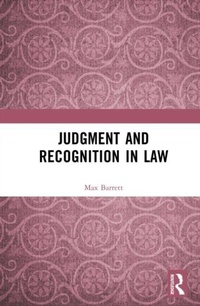
Judgment and Recognition in Law
1st Edition
Will be published approx. on 7. September 2026
Book
Hardback
276 pages
978-1-041-34876-4 (ISBN)
Description
Justice begins in the fragments. While the legal system excels at classification and resolution, it often fails at recognition. Written from the bench by an Irish High Court judge, this book challenges the administrative sublime of modern bureaucracy, which sees persons too often converted into risk scores and bullet points.
Blending lived judicial experience with queer theory, literature, and philosophy, this book proposes a jurisprudence of attentive refusal to let the human disappear into procedural fluency. From piccolo paeans to global postage stamps to reflections on the moral motion of the soul, this book re-defines the judge's task as being not just to decide, but to listen for the stutter and the shimmer that the official record can forget. Structured as a reflective journey across hemispheres - from the Global North to the Global South and back to Ireland - the book weaves the thoughts of various thinkers, from Aquinas and Baldwin to Butler and Munoz, into a form of lyrical jurisprudence. Reflecting on the inner life of judging, that is to say the moral and imaginative dimensions of law as they unfold in attention, silence, and refusal, the book offers a companion to legal practice that invites readers to think again about what it means to judge, to recognise, and to stay near the lives that law touches. Judgment, it maintains, is not mere decision but an act of ethical attention, a form of seeing that keeps the human in view.
This book will appeal to academics and advanced students in the areas of jurisprudence, legal theory, ethics, and law and literature, as well as others with an interest in the ethics and practice of legal judgment.
Blending lived judicial experience with queer theory, literature, and philosophy, this book proposes a jurisprudence of attentive refusal to let the human disappear into procedural fluency. From piccolo paeans to global postage stamps to reflections on the moral motion of the soul, this book re-defines the judge's task as being not just to decide, but to listen for the stutter and the shimmer that the official record can forget. Structured as a reflective journey across hemispheres - from the Global North to the Global South and back to Ireland - the book weaves the thoughts of various thinkers, from Aquinas and Baldwin to Butler and Munoz, into a form of lyrical jurisprudence. Reflecting on the inner life of judging, that is to say the moral and imaginative dimensions of law as they unfold in attention, silence, and refusal, the book offers a companion to legal practice that invites readers to think again about what it means to judge, to recognise, and to stay near the lives that law touches. Judgment, it maintains, is not mere decision but an act of ethical attention, a form of seeing that keeps the human in view.
This book will appeal to academics and advanced students in the areas of jurisprudence, legal theory, ethics, and law and literature, as well as others with an interest in the ethics and practice of legal judgment.
More details
Language
English
Place of publication
London
United Kingdom
Publishing group
Taylor & Francis Ltd
Target group
Professional and scholarly
Academic
Dimensions
Height: 234 mm
Width: 156 mm
ISBN-13
978-1-041-34876-4 (9781041348764)
Copyright in bibliographic data and cover images is held by Nielsen Book Services Limited or by the publishers or by their respective licensors: all rights reserved.
Schweitzer Classification
Other editions
Additional editions

Max Barrett
Judgment and Recognition in Law
E-Book
approx. 09/2026
1st Edition
Taylor & Francis
€60.49
Not yet available
Max Barrett
Judgment and Recognition in Law
E-Book
approx. 09/2026
1st Edition
Taylor & Francis
€60.49
Not yet available
Person
Max Barrett, Judge on the High Court of Ireland.
Content
Part 1: North by Northwest 1. On Judgement and the Refusal to Disappear 2. The Person, Not the Profile 3. To Be Seen No Longer 4. The Moral Core of Judgment Part 2: North and South 5. Orientation and the Trace of Judgement Part 3: South to East 6. Moral Motion and the Purpose of Law 7. Locke, Presence, and the Ethics of Judgment 8. The Limits of Law: On Judgment, Misrecognition, and the Refusal to Vanis... 9. What Am I For? Judgment and the Moral Architecture of Law Part 4: Back to Dublin
10. Judging in the Key of Erasure 11. The Oath of Courage 12. Conclusion: A Jurisprudence of Attention
10. Judging in the Key of Erasure 11. The Oath of Courage 12. Conclusion: A Jurisprudence of Attention