

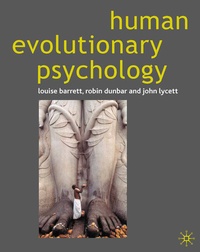
Human Evolutionary Psychology
Published on 26. November 2001
Book
Paperback/Softback
XIV, 438 pages
978-0-333-72558-0 (ISBN)
Description
This textbook offers a comprehensive overview of human behaviour and psychology from an evolutionary perspective. The combination of broad scope and in-depth analysis makes it the ideal introduction to this exciting and rapidly expanding area of research.
Reviews / Votes
'This is more than a much needed comprehensive introductory text to the area. It is an antidote to the erroneous view that evolutionary approaches to human psychology and action is some monolithic view focussed solely upon the concept of adaptation and reproductive success. As this book shows, it is many things, including the study of the causal powers and origins of human culture. If this book has a single message, it is long live pluralism.' - Henry Plotkin, Professor of Psychobiology, University College London. 'A monumental work. Buy it for the bibliography list. Read it for the pleasure of seeing a powerful new field making the transition to maturity.' - Randolph Nesse, M.D., Director, Evolution and Human Adaptation Program, University of Michigan and coauthor (with George Williams) of Why We Get Sick 'This is an impressive review of the literature on the evolution of human behaviour, including human evolutionary ecology and psychology. It will be a useful teaching resource, and there is nothing quite like it currently available.' - Ruth Mace, University College London 'This well-written and balanced textbook presents the complexity of the debate over evolutionary psychology. A valuable addition to the teaching resources for the growing area of evolutionary psychology, it provides the foundational information that allows students to confront the primary source material.' - Steven Scher, Eastern Illinois UniversityMore details
Edition
2001
Language
English
Place of publication
London
United Kingdom
Publishing group
Bloomsbury Publishing PLC
Target group
College/higher education
Professional and scholarly
Product notice
Paperback (trade)
Dimensions
Height: 254 mm
Width: 203 mm
Thickness: 24 mm
Weight
962 gr
ISBN-13
978-0-333-72558-0 (9780333725580)
DOI
10.1007/978-1-137-23550-3
Schweitzer Classification
Other editions
Additional editions
Louise Barrett | Robin Dunbar | John Lycett
Human Evolutionary Psychology
Book
11/2001
Red Globe Press
€161.56
Article exhausted; check different version
Persons
ROBIN DUNBAR is Professor of Evolutionary Psychology at the University of Liverpool (previously Professor of Biological Anthropology at University College, London). He is the author of 9 books and 103 articles for, among others, Nature and New Scientist.
LOUISE BARRETT is Lecturer in Evolutionary Psychology and Behavioural Ecology at the University of Liverpool. Her research interests lie in the evolution of cognition and the socioecology of human and non-human primates and she is co-director of the De Hoop Baboon Project in South Africa.
JOHN LYCETT is Lecturer in Evolutionary Psychology at the University of Liverpool. His current research interests are in human reproductive decision making and parental investment decisions.
LOUISE BARRETT is Lecturer in Evolutionary Psychology and Behavioural Ecology at the University of Liverpool. Her research interests lie in the evolution of cognition and the socioecology of human and non-human primates and she is co-director of the De Hoop Baboon Project in South Africa.
JOHN LYCETT is Lecturer in Evolutionary Psychology at the University of Liverpool. His current research interests are in human reproductive decision making and parental investment decisions.
Content
Preface.- The Evolutionary Approach to Human Behaviour.- Basics of Evolutionary Theory.- Cooperation Among Kin.- Reciprocity and Sharing.- Mate Choice.- Life History Constraints and Reproductive Decisions.- Parental Investment Strategies.- Marriage and Inheritance .- The Individual in Society.- Cognition and the Modular Brain.- Social Cognition and its Development.- Language.- Cultural Evolution.- References.