

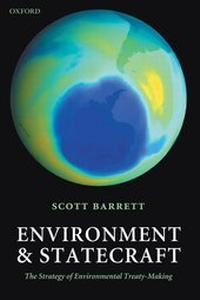
Environment and Statecraft
The Strategy of Environmental Treaty-Making
Published on 10. November 2005
Book
Paperback/Softback
456 pages
978-0-19-928609-6 (ISBN)
Description
Environmental problems like global climate change and stratospheric ozone depletion can only be remedied if states cooperate with one another. But sovereign states usually care only about their own interests. So states must somehow restructure the incentives to make cooperation pay. This is what treaties are meant to do.
A few treaties, such as the Montreal Protocol on Substances that Deplete the Ozone Layer, succeed. Most, however, fail to alter the state behaviour appreciably. This book develops a theory that explains both the successes and the failures. In particular, the book explains when treaties are needed, why some work better than others, and how treaty design can be improved. The best treaties strategically manipulate the incentives states have to exploit the environment, and the theory developed in this book shows how treaties can do this.
The theory integrates a number of disciplines, including economics, political science, international law, negotiation analysis, and game theory. It also offers a coherent and consistent approach. The essential assumption is that treaties be self-enforcing-that is, individually rational, collectively rational, and fair.
The book applies the theory to a number of environmental problems. It provides information on more than three hundred treaties, and analyses a number of case studies in detail. These include depletion of the ozone layer, whaling, pollution of the Rhine, acid rain, over-fishing, pollution of the oceans, and global climate change.
The essential lesson of the book is that treaties should not just tell countries what to do. Treaties must make it in the interests of countries to behave differently. That is, they must restructure the underlying game. Most importantly, they must create incentives for states to participate in a treaty and for parties to comply.
A few treaties, such as the Montreal Protocol on Substances that Deplete the Ozone Layer, succeed. Most, however, fail to alter the state behaviour appreciably. This book develops a theory that explains both the successes and the failures. In particular, the book explains when treaties are needed, why some work better than others, and how treaty design can be improved. The best treaties strategically manipulate the incentives states have to exploit the environment, and the theory developed in this book shows how treaties can do this.
The theory integrates a number of disciplines, including economics, political science, international law, negotiation analysis, and game theory. It also offers a coherent and consistent approach. The essential assumption is that treaties be self-enforcing-that is, individually rational, collectively rational, and fair.
The book applies the theory to a number of environmental problems. It provides information on more than three hundred treaties, and analyses a number of case studies in detail. These include depletion of the ozone layer, whaling, pollution of the Rhine, acid rain, over-fishing, pollution of the oceans, and global climate change.
The essential lesson of the book is that treaties should not just tell countries what to do. Treaties must make it in the interests of countries to behave differently. That is, they must restructure the underlying game. Most importantly, they must create incentives for states to participate in a treaty and for parties to comply.
Reviews / Votes
... a truly important contribution to the literature on international environmental cooperation. * Journal of Institutional and Theoretical Economics *More details
Language
English
Place of publication
Oxford
United Kingdom
Target group
Professional and scholarly
Academics in economics, international relations, and environmental science, Negotiators, NGOs, and the general reader with an interest in environmental politics.
Illustrations
Numerous line drawings
Dimensions
Height: 235 mm
Width: 156 mm
Thickness: 25 mm
Weight
689 gr
ISBN-13
978-0-19-928609-6 (9780199286096)
Copyright in bibliographic data and cover images is held by Nielsen Book Services Limited or by the publishers or by their respective licensors: all rights reserved.
Schweitzer Classification
Other editions
Additional editions
Book
01/2003
Oxford University Press
€106.50
Article exhausted; check different version
Person
Scott Barrett is Professor of Environmental Economics and International Political Economy at the Paul H. Nitze School of Advanced International Studies, Johns Hopkins University. He was educated in the US, Canada, and Britain and taught previously at the London Business School.
Content
1. Introduction ; 2. The North Pacific Fur Seal Treaty and the Theory of International Cooperation ; 3. Transnational Cooperation Dilemmas ; 4. Games with Multiple Equilibria ; 5. Customary Rights and Responsibilities ; 6. International Environmental Agreements ; 7. The Treaty Participation Game ; 8. The Montreal Protocol ; 9. Tipping Treaties ; 10. Compliance and the Strategy of Reciprocity ; 11. The Depth and Breadth of International Cooperation ; 12. Trade Leakage and Trade Linkage ; 13. The Side Payments Game ; 14. Summary ; 15. Global Climate Change and the Kyoto Protocol