

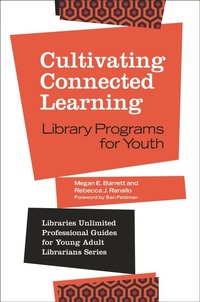
Cultivating Connected Learning
Library Programs for Youth
Published on 1. June 2018
Book
Paperback/Softback
150 pages
978-1-4408-5538-2 (ISBN)
Description
If you want to boost your library's relevancy and support youth learning, consider incorporating connected learning at your library. This book helps you to realize the potential of this exciting and dynamic trend.
Learning doesn't just happen in the classroom: it happens everywhere. The connected learning model supports this principle, asserting that young people learn best when their experiences are interest-driven, peer-supported, and rooted in solid academics. Libraries are the perfect environment for this type of learning, providing a place where teens can connect with each other and with adult mentors to engage with learning material and thrive.
This book shows you how to cultivate connected learning in your library. You'll discover what the approach involves, its benefits, and what it can look like in various library settings. You'll also learn how to generate support for connecting learning within your library; reimagine your spaces and programs to better support connected learning; integrate technology into programs and services to make it accessible to youth; build partnerships with other libraries as well as other organizations; recruit volunteers; and raise community awareness to increase involvement.
Learning doesn't just happen in the classroom: it happens everywhere. The connected learning model supports this principle, asserting that young people learn best when their experiences are interest-driven, peer-supported, and rooted in solid academics. Libraries are the perfect environment for this type of learning, providing a place where teens can connect with each other and with adult mentors to engage with learning material and thrive.
This book shows you how to cultivate connected learning in your library. You'll discover what the approach involves, its benefits, and what it can look like in various library settings. You'll also learn how to generate support for connecting learning within your library; reimagine your spaces and programs to better support connected learning; integrate technology into programs and services to make it accessible to youth; build partnerships with other libraries as well as other organizations; recruit volunteers; and raise community awareness to increase involvement.
Reviews / Votes
This is a well-researched and helpful guide for public and school librarians looking to add or supplement programming for young adults, regardless of budget or staff. * Booklist Online * Numerous thoughtful STEAM-oriented programs are carefully outlined, with steps, supplies, and desired outcomes. . . . A pragmatic addition for school and public librarians who work with teens. * School Library Journal *More details
Series
Language
English
Place of publication
United States
Publishing group
Bloomsbury Publishing Plc
Target group
Professional and scholarly
Primary & secondary/elementary & high school
Dimensions
Height: 234 mm
Width: 156 mm
Thickness: 8 mm
Weight
240 gr
ISBN-13
978-1-4408-5538-2 (9781440855382)
Copyright in bibliographic data and cover images is held by Nielsen Book Services Limited or by the publishers or by their respective licensors: all rights reserved.
Schweitzer Classification
Other editions
Additional editions
E-Book
06/2018
1st Edition
Libraries Unlimited Inc
€47.49
Available for download
E-Book
06/2018
1st Edition
Libraries Unlimited Inc
€47.49
Available for download
Persons
Megan E. Barrett is Information & Technology Literacy Specialist for Cuyahoga County Public Library, where she coordinates technology programs. She also works with staff to facilitate programs that foster connected learning in their branches.
Rebecca J. Ranallo is Information & Technology Literacy Manager for Cuyahoga County Public Library, where she oversees innovation, implementation, and training.
Rebecca J. Ranallo is Information & Technology Literacy Manager for Cuyahoga County Public Library, where she oversees innovation, implementation, and training.
Content
Series Foreword
Foreword
Preface
Acknowledgments
Introduction
1 Connected Learning
2 Creating Your Plan
3 Finding Your Space
4 Developing Your Collection
5 Staffing and Running the Program
6 Planning the Programs
7 Marketing and Promoting the Program
8 Assess and Refine
Appendix A: Connected Learning Resources
Appendix B: Forms
References
Bibliography
Index
About the Authors
Foreword
Preface
Acknowledgments
Introduction
1 Connected Learning
2 Creating Your Plan
3 Finding Your Space
4 Developing Your Collection
5 Staffing and Running the Program
6 Planning the Programs
7 Marketing and Promoting the Program
8 Assess and Refine
Appendix A: Connected Learning Resources
Appendix B: Forms
References
Bibliography
Index
About the Authors