

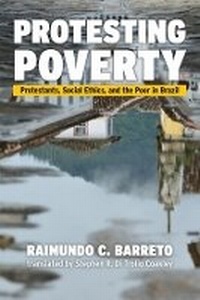
Protesting Poverty
Protestants, Social Ethics, and the Poor in Brazil
Published on 1. April 2023
Book
Paperback/Softback
300 pages
978-1-4813-1683-5 (ISBN)
Description
At a time when Latin American Protestantism has increasingly become a force to be reckoned with in the public realm and has attracted growing scholarly interest, this book contributes to the understanding of the sociopolitical relevance of the Protestant presence in Brazilian history and society. Raimundo Barreto argues that progressive Evangelicx Christianity, a branch of Brazilian Christianity that combines charismatic spirituality and sociopolitical progressive action, offers valuable sources for Christian social ethics in contemporary Brazil.
Drawing on the typology proposed by Jose Miguez Bonino in his Faces of Latin American Protestantism (1993), which examined the Latin American Protestant field through the analogy of fundamental "faces," Protesting Poverty interrogates three Protestant faces-ecumenical, evangelical, and Pentecostal-in the Brazilian context as well as their respective responses to realities of suffering, injustice, and oppression. The common thread of the argument is the search for a Brazilian Protestant social ethics, a progressive Christian sociopolitical praxis in a Protestant key. A spirituality that combines key elements of these three ethical responses is at the root of a theological ethics capable of promoting substantive social transformation that impacts both the individual and society at large.
The interrogation of the three specific Protestant responses to the plight of the poor is thus presented as a map toward a Christian social ethics that can effectively respond to the demands of justice. Barreto adopts an inductive approach that seeks to learn from these specific Brazilian Protestant "faces" to advance what Orlando Espin has called "universally relevant truth claims." At a time when ecumenical relations are being relocated and reinvented to address the conflicts and demands of a new era, this sociohistorical study points to new ecumenical possibilities.
Drawing on the typology proposed by Jose Miguez Bonino in his Faces of Latin American Protestantism (1993), which examined the Latin American Protestant field through the analogy of fundamental "faces," Protesting Poverty interrogates three Protestant faces-ecumenical, evangelical, and Pentecostal-in the Brazilian context as well as their respective responses to realities of suffering, injustice, and oppression. The common thread of the argument is the search for a Brazilian Protestant social ethics, a progressive Christian sociopolitical praxis in a Protestant key. A spirituality that combines key elements of these three ethical responses is at the root of a theological ethics capable of promoting substantive social transformation that impacts both the individual and society at large.
The interrogation of the three specific Protestant responses to the plight of the poor is thus presented as a map toward a Christian social ethics that can effectively respond to the demands of justice. Barreto adopts an inductive approach that seeks to learn from these specific Brazilian Protestant "faces" to advance what Orlando Espin has called "universally relevant truth claims." At a time when ecumenical relations are being relocated and reinvented to address the conflicts and demands of a new era, this sociohistorical study points to new ecumenical possibilities.
More details
Language
English
Place of publication
Waco
United States
Target group
Professional and scholarly
Product notice
Paperback (trade)
Dimensions
Height: 229 mm
Width: 152 mm
Thickness: 22 mm
Weight
363 gr
ISBN-13
978-1-4813-1683-5 (9781481316835)
Copyright in bibliographic data and cover images is held by Nielsen Book Services Limited or by the publishers or by their respective licensors: all rights reserved.
Schweitzer Classification
Other editions
Additional editions
E-Book
11/2023
Baylor University Press
€54.49
Available for download
Persons
Raimundo C. Barreto is Associate Professor of World Christianity at Princeton Theological Seminary.
Content
Introduction
1 Face to Face with the Poor
2 The Role and Significance of Richard Shaull in Latin America
3 The Ecumenical Response
4 The Evangelical Response
5 The Pentecostal Response
6 Towards an Evangelica/o Progressive Social Ethics
1 Face to Face with the Poor
2 The Role and Significance of Richard Shaull in Latin America
3 The Ecumenical Response
4 The Evangelical Response
5 The Pentecostal Response
6 Towards an Evangelica/o Progressive Social Ethics