

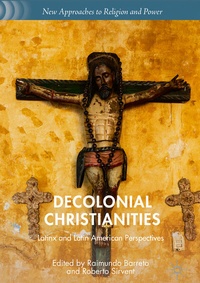
Decolonial Christianities
Description
What does it mean to theorize Christianity in light of the decolonial turn? This volume invites distinguished Latinx and Latin American scholars to a conversation that engages the rich theoretical contributions of the decolonial turn, while relocating Indigenous, Afro-Latin American, Latinx, and other often marginalized practices and hermeneutical perspectives to the center-stage of religious discourse in the Americas. Keeping in mind that all religions-Christianity included-are cultured, and avoiding the abstract references to Christianity common to the modern Eurocentric hegemonic project, the contributors favor embodied religious practices that emerge in concrete contexts and communities. Featuring essays from scholars such as Sylvia Marcos, Enrique Dussel, and Luis Rivera-Pagán, this volume represents a major step to bring Christian theology into the conversation with decolonial theory.
Reviews / Votes
"This thoughtful and timely volume deftly explores multiple paths toward the decolonization of Christian belief and practice. Its essays by philosophers, historians, and religious scholars place the concerns of Indigenous, Afro-Latin, working-class, and queer historical actors at the center of decolonization strategies. Highly recommended for anyone interested in Latin American Christianities." (David Tavárez, author of The Invisible War (2011))" Decolonial Christianities opens the door to the much needed engagement between the decolonial project and the Christian tradition. Three grounding essays by Enrique Dussel, Luis Rivera-Pagán, and Sylvia Marcos examine the historical symbiosis between Christianit ies and coloniality. These serve as a platform from which contributors launch a series of reflections that critically place the decolonial project in dialogue with Christianit ies . Contributors who have navigated decolonial themes in their work on gender, class, race, indigenous liberation, ecclesiologies, and political projects, challenge the reader with complex observations about the violence and damage imposed by this relationship. In turn, they offer honest appraisals of which dimensions of the Christian story bear the seed of unbinding humanity from the specter of local and global relations characterized by colonial domination. As an ethicist this collection pushed me to reconsider how I imagine liberation for multiple marginalities, and to critically assess the tools with which I engage diverse projects for justice and transformation." (María Teresa Dávila, Lecturer in Religious and Theological Studies, Merrimack College, USA)
More details
Other editions
Additional editions
Persons
Raimundo Barreto is Assistant Professor of World Christianity at Princeton Theological Seminary.
Roberto Sirvent is Professor of Political and Social Ethics at Hope International University in Fullerton, California.