

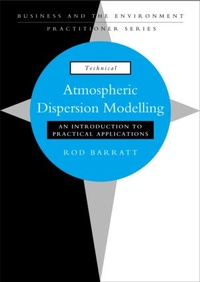
Atmospheric Dispersion Modelling
An Introduction to Practical Applications
1st Edition
Published on 1. December 2001
Book
Paperback/Softback
166 pages
978-1-85383-642-8 (ISBN)
Description
To comply with legal and other standards, businesses and regulators are increasingly required to make decisions based on risk assessments of the potential effects of their activities on the environment. Atmospheric dispersion modelling is a cost-effective method, allowing various scenarios to be explored before expensive investment takes place. This guide offers advice on this environmental management tool. Unlike much of the previous literature, it doesn't focus excessively on the mathematical theory behind the modelling or on modelling for specific regulatory purposes. Instead, it offers an understanding of the background to the methodologies, providing exercises to develop the skills to carry these out and including examples of the use of commercially available models to enable the reader to assess the results of modelling for risk assessment.
More details
Series
Language
English
Place of publication
London
United Kingdom
Publishing group
Taylor & Francis Ltd
Target group
Professional and scholarly
Dimensions
Height: 297 mm
Width: 210 mm
Weight
453 gr
ISBN-13
978-1-85383-642-8 (9781853836428)
Copyright in bibliographic data and cover images is held by Nielsen Book Services Limited or by the publishers or by their respective licensors: all rights reserved.
Schweitzer Classification
Other editions
Additional editions
Book
12/2016
1st Edition
Routledge
€207.98
Shipment within 10-20 days
E-Book
11/2013
1st Edition
Routledge
€205.99
Available for download
E-Book
11/2013
1st Edition
Routledge
€205.99
Available for download
Person
A Chartered Chemist by profession, Dr Rod Barratt has spent most of his career in the teaching and practice of air quality management. He built a practical foundation in his subject in local government environmental protection and engineering consultancy. In 1987 he joined the Open University, where he is Head of the Department of Environmental and Mechanical Engineering. His teaching interests focus on air quality management and wider aspects of safety, health and environmental management.In addition to about 40 journal publications, he has written two books dealing with environmental management, and has contributed a chapter on energy management to a book on clean technology. As an expert witness, he has used atmospheric dispersion modelling in developing evidence for public inquiries relating to the planning aspects of road, industrial and mineral working activities.
Content
Why Model Air Quality? * Types of Model * Understanding the Atmosphere * Emission Inventories * The Gaussian Plume Dispersion Model * Simple Modelling for Point and Mobile Sources * Refined Computer Models * Modelling Emergency Releases * Practical Applications * Modelling Guidelines * Appendix 1: Air Quality Standards * Appendix 2: Land Use Categories * Appendix 3: Selected Model Summaries * Appendix 4: Selected Sources of Additional Information * Appendix 5: Web Addresses * Appendix 6: Solutions to Exercise * Appendix 7: Glossary * Index