

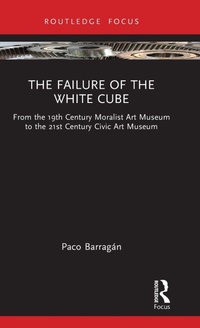
The Failure of the White Cube
From the 19th Century Moralist Art Museum to the 21st Century Civic Art Museum
1st Edition
Published on 21. April 2026
Book
Hardback
130 pages
978-1-041-12839-7 (ISBN)
Description
This provocative book bridges the gap between theoretical academic writings and practical museum curating, tracing the journey from 19th-century moralist art museums to today's 21st-century inclusive civic art museums via a sustained critique of the 20th-century formalist and heteronormative white cube model of curating in art museums.
The book offers a comparative analysis of the 19th-century moralist art museum, the 20th-century formalist art museum and the 21st-century civic art museum. It critiques the white cube model, highlighting its failure to address contemporary issues of gender, identity, race and inclusivity. The author provides a clear genealogy of the white cube, detailing its six phases and charting its development and global expansion from the 1900s in Austria and Germany to the 2020s. Additionally, the book examines successful non-white cube museologies and exhibition designs before proposing a practical eight-step methodology for curatorial and exhibition design aimed at overcoming the limitations of the traditional white cube. The analysis draws on numerous detailed case studies and integrates insights from museum studies, art history, art market, collecting, institutional art systems, curatorial studies, cultural studies and practical curatorial experience.
This thought-provoking research will be of interest to students, researchers and practitioners in the fields of museum studies, art history, architecture and exhibition design, and especially curatorial practice.
The book offers a comparative analysis of the 19th-century moralist art museum, the 20th-century formalist art museum and the 21st-century civic art museum. It critiques the white cube model, highlighting its failure to address contemporary issues of gender, identity, race and inclusivity. The author provides a clear genealogy of the white cube, detailing its six phases and charting its development and global expansion from the 1900s in Austria and Germany to the 2020s. Additionally, the book examines successful non-white cube museologies and exhibition designs before proposing a practical eight-step methodology for curatorial and exhibition design aimed at overcoming the limitations of the traditional white cube. The analysis draws on numerous detailed case studies and integrates insights from museum studies, art history, art market, collecting, institutional art systems, curatorial studies, cultural studies and practical curatorial experience.
This thought-provoking research will be of interest to students, researchers and practitioners in the fields of museum studies, art history, architecture and exhibition design, and especially curatorial practice.
Reviews / Votes
Paco Barragan's book is a breath of fresh air in museological literature. Drawing on examples from antiquity to the present, he offers a passionate and persuasive argument that the 'white cube' does not deserve the dominance it has enjoyed for decades.Andreas Bluehm, Professor Art History and former Head of Exhibitions & Display Van Gogh Museum
Paco Barragan's book dismantles many of the popular notions surrounding contemporary art's most dominant exhibition model - the white cube - and the historical conditions that contributed to its creation and establishment. Well-researched, witty, provocative, informative, polemical, at times infuriating, Barragan's writing is challenging but ultimately thought-provoking - the essential ingredient of every good book.
Michele Robecchi, Editor Phaidon Press
Paco Barragan dives polemically, but with great knowledge and depth into the problematics of exhibition spaces, offering for sure food for thought, not just for curators and art historians, but also for artists, dealers and exhibition designers. This book is like a civilized stranger that joins your table in the bar and leaves you perplexed.
Max Ryynaenen, Lecturer Visual Culture Alvar Aalto University
More details
Series
Language
English
Place of publication
London
United Kingdom
Publishing group
Taylor & Francis Ltd
Target group
College/higher education
Professional and scholarly
Academic, Postgraduate, Professional Practice & Development, and Undergraduate Advanced
Illustrations
14 s/w Photographien bzw. Rasterbilder, 2 s/w Zeichnungen, 16 s/w Abbildungen
2 Line drawings, black and white; 14 Halftones, black and white; 16 Illustrations, black and white
Dimensions
Height: 145 mm
Width: 223 mm
Thickness: 13 mm
Weight
294 gr
ISBN-13
978-1-041-12839-7 (9781041128397)
Copyright in bibliographic data and cover images is held by Nielsen Book Services Limited or by the publishers or by their respective licensors: all rights reserved.
Schweitzer Classification
Other editions
Additional editions
Paco Barragan
The Failure of the White Cube
From the 19th Century Moralist Art Museum to the 21st Century Civic Art Museum
E-Book
04/2026
1st Edition
Routledge
€28.99
Available for download
Paco Barragan
The Failure of the White Cube
From the 19th Century Moralist Art Museum to the 21st Century Civic Art Museum
E-Book
04/2026
1st Edition
Routledge
€28.99
Available for download
Person
Paco Barragan is a curator, exhibition designer and cultural theorist. His curatorial work emerges from research-through-practice operating at the intersections of curating, theory, exhibition design and institutional analysis. He has curated 99 exhibitions in the Americas, Europe and Oceania and was previously Head of the Visual Arts at Cultural Arts Centre, Matucana 100, in Santiago de Chile. He is the author of From Roman Feria to Global Art Fair, From Olympia Festival to Neo-Liberal Biennial: On the 'Biennialization' of Art Fairs and the 'Fairization' of Biennials (2020) and The Art Fair Age (2009) and a co-editor of The Changing Meaning of Kitsch: From Rejection to Acceptance (2023) and When a Painting Moves... Something Must Be Rotten (2011).
Content
Introduction 1 The private museum: Six types of collectors that paved the way for today's public art museum, 685 BC-2020s 2 The moralist art museum: The Universal Survey Museum, 1793-1880s 3 The aesthetic art museum: The period room and other experimental displays, 1880s-1940s 4 The formalist art museum: The modern period room or the white cube and its six phases, 1900-2020s 5 The civic art museum: Participation and contextual
displays for the 21st century 6 Bad museology or how museums are killing artworks with bad placement and anachronism 7 An eight-step methodology for articulating exhibitions beyond the failed white cube
displays for the 21st century 6 Bad museology or how museums are killing artworks with bad placement and anachronism 7 An eight-step methodology for articulating exhibitions beyond the failed white cube