

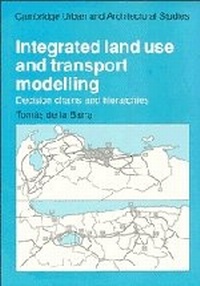
Integrated Land Use and Transport Modelling
Decision Chains and Hierarchies
Published on 13. July 1989
Book
Hardback
196 pages
978-0-521-24318-6 (ISBN)
Description
The integration of the location of activities in space and the use of transport has been a theoretical planning issue for many years. However, most books on this subject treat each component of the land use and transportation system with different, sometimes even conflicting, theories. The purpose of this book is to present the issue in the light of a single and consistent theoretical framework, that of random utility theory and discrete choice models. This is achieved in a methodical way, reviewing microeconomic theory related to the use of space, spatial interaction models, entropy maximising models, and finally, random utility theory. Emphasis is given to the concepts of decision chains and hierarchies. Spatial input-output models are also discussed, followed by chapters specifically dealing with the location of activities, the land market and the transport system. The book ends with the description of a number of real case studies to show how the theory can be used in practice.
More details
Series
Language
English
Place of publication
Cambridge
United Kingdom
Target group
Professional and scholarly
Dimensions
Height: 255 mm
Width: 180 mm
Thickness: 18 mm
Weight
570 gr
ISBN-13
978-0-521-24318-6 (9780521243186)
Copyright in bibliographic data and cover images is held by Nielsen Book Services Limited or by the publishers or by their respective licensors: all rights reserved.
Schweitzer Classification
Other editions
New editions
Book
11/2005
Cambridge University Press
€58.90
Shipment within 15-20 days
Additional editions
Book
11/2005
Cambridge University Press
€58.90
Shipment within 15-20 days
Person
Content
List of figures; Preface; Acknowledgements; 1. Social science and planning; 2. Micro-economic theories of land use; 3. Spatial interaction models; 4. Random utility theory and discrete choice models; 5. Spatial accounting models; 6. Urban and regional activity allocation; 7. The transportation system; 8. Applications of TRANUS, an integrated land use and transport model; Appendix; References; Index.