

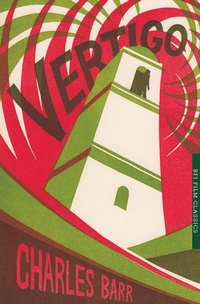
Vertigo
2nd Edition
Published on 31. July 2012
Book
Paperback/Softback
112 pages
978-1-84457-498-8 (ISBN)
Description
Vertigo (1958) is widely regarded as not only one of Hitchcock's best films, but one of the greatest films of world cinema. Made at the time when the old studio system was breaking up, it functions both as an embodiment of the supremely seductive visual pleasures that 'classical Hollywood' could offer and - with the help of an elaborate plot twist - as a laying bare of their dangerous dark side. The film's core is a study in romantic obsession, as James Stewart's Scottie pursues Madeleine/Judy (Kim Novak) to her death in a remote Californian mission. Novak is ice cool but vulnerable, Stewart - in the darkest role of his career - genial on the surface but damaged within.
Although it can be seen as Hitchcock's most personal film, Charles Barr argues that, like Citizen Kane, Vertigo is at the same time a triumph not so much of individual authorship as of creative collaboration. He highlights the crucial role of screenwriters Alec Coppel and Samuel Taylor and, by a combination of textual and contextual analysis, explores the reasons why Vertigo continues to inspire such fascination.
In his foreword to this special edition, published to celebrate the 20th anniversary of the BFI Film Classics series, Barr looks afresh at Vertigo alongside the recently-rediscovered 'lost' silent The White Shadow (1924), scripted by Hitchcock, which also features the trope of the double, and at the acclaimed contemporary silent film The Artist (2011), which pays explicit homage to Vertigo in its soundtrack.
Although it can be seen as Hitchcock's most personal film, Charles Barr argues that, like Citizen Kane, Vertigo is at the same time a triumph not so much of individual authorship as of creative collaboration. He highlights the crucial role of screenwriters Alec Coppel and Samuel Taylor and, by a combination of textual and contextual analysis, explores the reasons why Vertigo continues to inspire such fascination.
In his foreword to this special edition, published to celebrate the 20th anniversary of the BFI Film Classics series, Barr looks afresh at Vertigo alongside the recently-rediscovered 'lost' silent The White Shadow (1924), scripted by Hitchcock, which also features the trope of the double, and at the acclaimed contemporary silent film The Artist (2011), which pays explicit homage to Vertigo in its soundtrack.
More details
Series
Edition
2nd edition
Language
English
Place of publication
London
United Kingdom
Publishing group
Bloomsbury Publishing PLC
Illustrations
24 colour photos, 41 b/w photos
Dimensions
Height: 188 mm
Width: 54 mm
Thickness: 17 mm
Weight
204 gr
ISBN-13
978-1-84457-498-8 (9781844574988)
DOI
10.1057/9781137296764
Copyright in bibliographic data and cover images is held by Nielsen Book Services Limited or by the publishers or by their respective licensors: all rights reserved.
Schweitzer Classification
Other editions
Person
CHARLES BARR was formerly Professor of Film Studies at the University of East Anglia. He is Adjunct Professor at the John Huston Centre for Film and Digital Media, part of the National University of Ireland in Galway, and is active on the editorial boards of the online Movie: a Journal of Film Criticism and the US-based scholarly journal The Hitchcock Annual. His pioneering work on British cinema includes Ealing Studios (rev. edn, 1999) and English Hitchcock (1999), and, as editor, All Our Yesterdays: 90 Years of British Cinema (1986). He was the researcher and co-writer of Stephen Frears' film Typically British: A Personal History of British Cinema (1995).
Content
Foreword.- Acknowledgments.- 1 Obsession.- 2 Construction.- 3 Illusion.- 4 Revelation.- Notes.- Credits.- Bibliography.