

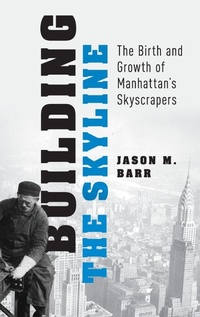
Building the Skyline
The Birth and Growth of Manhattan's Skyscrapers
Published on 7. July 2016
Book
Hardback
456 pages
978-0-19-934436-9 (ISBN)
Description
The Manhattan skyline is one of the great wonders of the modern world. But how and why did it form? Much has been written about the city's architecture and its general history, but little work has explored the economic forces that created the skyline. This book chronicles the economic history of the Manhattan skyline. In the process, the book debunks some widely-held misconceptions about the city's history. Part I lays out the historical and environmental background that established Manhattan's real estate trajectory before the Skyscraper Revolution at the end of the 19th century. The book begins with Manhattan's natural and geological history and then moves on to how it influenced early land use and neighborhood formation, and how these early decisions eventually impacted the location of skyscrapers. Part II focuses specifically on the economic history of skyscrapers and the skyline, investigating the reasons for their heights, frequencies, locations, and shapes. The book discusses why skyscrapers emerged downtown and why they appeared three miles to the north in midtown, but not in between. Contrary to popular belief it was not due to the depths of Manhattan's bedrock, nor the presence of Grand Central Station. Rather midtown's emergence was a response to the economic and demographic forces that were taking place north of 14th Street after the Civil War. The book also presents the first rigorous investigation of the causes of the building boom during the Roaring Twenties. Contrary to conventional wisdom, the boom was largely a rational response to the economic growth of the nation and city. The last chapter investigates the value of Manhattan Island and the relationship between skyscrapers and land prices. Finally, an Epilogue offers policy recommendations for a resilient and robust future skyline.
Reviews / Votes
if you're remotely interested in New York skyscrapers, I can say with confidence that there is a one hundred percent chance youre going to appreciate * Jan Klerks, SkyscraperCity *More details
Language
English
Place of publication
New York
United States
Target group
College/higher education
Professional and scholarly
Dimensions
Height: 240 mm
Width: 161 mm
Thickness: 29 mm
Weight
845 gr
ISBN-13
978-0-19-934436-9 (9780199344369)
Copyright in bibliographic data and cover images is held by Nielsen Book Services Limited or by the publishers or by their respective licensors: all rights reserved.
Schweitzer Classification
Other editions
Additional editions
E-Book
05/2016
1st Edition
Oxford University Press
€26.39
Available for download
E-Book
05/2016
1st Edition
OUP eBook
€20.99
Available for download
Person
Jason M. Barr is an associate professor of economics at Rutgers University, Newark. His areas of interests include urban economics, New York City history, and computational economics. He has published many articles in top peer-reviewed economics journals. He is one of the leading scholars on skyscraper economics. His research has been discussed widely in the media, including in the New York Times, The Economist, National Public Radio, and the New York Observer. He has taught economics at Rutgers University-Newark, Dartmouth College, and Columbia University.
Content
PART I: BEFORE THE SKYSCRAPER REVOLUTION
1. Manhattan's Natural History
2. Mannahatta to Manhattan: Settlement to Grid Plan
3. Land Use before the Civil War
4. The Tenements and the Skyline
PART II: THE RISE OF THE SKYLINE
5. The Economics of Skyscraper Height
6. Measuring the Skyline
7. The Bedrock Myth
8. The Birth of Midtown
9. Edifice Complex? The Cause of the 1920s Building Boom
10. What's Manhattan Worth? 150 Years of Land Values
Epilogue: Resilient Skyline?
1. Manhattan's Natural History
2. Mannahatta to Manhattan: Settlement to Grid Plan
3. Land Use before the Civil War
4. The Tenements and the Skyline
PART II: THE RISE OF THE SKYLINE
5. The Economics of Skyscraper Height
6. Measuring the Skyline
7. The Bedrock Myth
8. The Birth of Midtown
9. Edifice Complex? The Cause of the 1920s Building Boom
10. What's Manhattan Worth? 150 Years of Land Values
Epilogue: Resilient Skyline?