

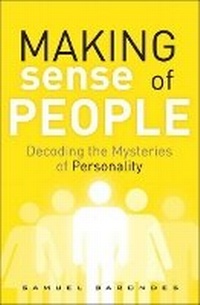
Making Sense of People
Decoding the Mysteries of Personality
Published on 21. July 2011
Book
Hardback
240 pages
978-0-13-217260-8 (ISBN)
Description
Every day, we evaluate the people around us: It's one of the most important things we ever do. Making Sense of People provides the scientific frameworks and tools we need to improve our intuition, and assess people more consciously, systematically, and effectively.
Leading neuroscientist Samuel H. Barondes explains the research behind each standard personality category: extraversion, agreeableness, conscientiousness, neuroticism, and openness. He shows readers how to use these traits and assessments to do a better job of deciding who they'll enjoy spending time with, whom to trust, and whom to keep at a distance. Barondes explains:
What neuroscience and psychological research can tell us about how personality types develop and cohere.
The intertwined roles of genes, nurture, and education in personality development.
How to recognize troublesome personality patterns such as narcissism, sociopathy, and paranoia.
How much a child's behavior predicts their adult personality, and how personality stabilizes in young adulthood.
How to assess integrity, fairness, wisdom, and other traits related to morality.
What genetic testing may (or may not) teach us about personality in the future.
General strategies for getting along with people, with specific tactics for special circumstances.
Kirkus Reviews A succinct look at personality psychology.
As a psychiatrist and neuroscientist at the University of California, Barondes (Molecules and Mental Illness, 2007, etc.) has spent years studying human behavior, and this book reflects his systematic, scientific approach for personality assessment. The average person isn't likely to have time to research a difficult boss or potential love interest, but the author supplements intuition with a useful cornerstone for gauging human behavior: a table of the "Big Five" personality traits, among them Extraversion vs. Introversion and Agreeableness vs. Antagonism. To learn how to apply the Big Five, Barondes supplies a link for a professional online personality test, in addition to a basic introduction of troubling personality patterns-e.g., narcissism and compulsiveness. While genetics may play a heavy hand in influencing personality, Barondes writes, it's awareness of a person's background, character and life story that is paramount in unearthing reasons for adult behavior. Readers might like to see the author weave more everyday examples into the text-his exercise in fostering compassion by imagining an adult as a 10-year-old child is a gem-but there is plenty here to ponder.
Those looking for traditional "self-help" advice won't find it here, but this book clearly lays the groundwork for deeper human interaction and better life relationships.
Leading neuroscientist Samuel H. Barondes explains the research behind each standard personality category: extraversion, agreeableness, conscientiousness, neuroticism, and openness. He shows readers how to use these traits and assessments to do a better job of deciding who they'll enjoy spending time with, whom to trust, and whom to keep at a distance. Barondes explains:
What neuroscience and psychological research can tell us about how personality types develop and cohere.
The intertwined roles of genes, nurture, and education in personality development.
How to recognize troublesome personality patterns such as narcissism, sociopathy, and paranoia.
How much a child's behavior predicts their adult personality, and how personality stabilizes in young adulthood.
How to assess integrity, fairness, wisdom, and other traits related to morality.
What genetic testing may (or may not) teach us about personality in the future.
General strategies for getting along with people, with specific tactics for special circumstances.
Kirkus Reviews A succinct look at personality psychology.
As a psychiatrist and neuroscientist at the University of California, Barondes (Molecules and Mental Illness, 2007, etc.) has spent years studying human behavior, and this book reflects his systematic, scientific approach for personality assessment. The average person isn't likely to have time to research a difficult boss or potential love interest, but the author supplements intuition with a useful cornerstone for gauging human behavior: a table of the "Big Five" personality traits, among them Extraversion vs. Introversion and Agreeableness vs. Antagonism. To learn how to apply the Big Five, Barondes supplies a link for a professional online personality test, in addition to a basic introduction of troubling personality patterns-e.g., narcissism and compulsiveness. While genetics may play a heavy hand in influencing personality, Barondes writes, it's awareness of a person's background, character and life story that is paramount in unearthing reasons for adult behavior. Readers might like to see the author weave more everyday examples into the text-his exercise in fostering compassion by imagining an adult as a 10-year-old child is a gem-but there is plenty here to ponder.
Those looking for traditional "self-help" advice won't find it here, but this book clearly lays the groundwork for deeper human interaction and better life relationships.
More details
Language
English
Place of publication
Upper Saddle River
United States
Publishing group
Pearson Education (US)
Target group
College/higher education
Dimensions
Height: 216 mm
Width: 183 mm
Thickness: 22 mm
Weight
380 gr
ISBN-13
978-0-13-217260-8 (9780132172608)
Copyright in bibliographic data and cover images is held by Nielsen Book Services Limited or by the publishers or by their respective licensors: all rights reserved.
Schweitzer Classification
Other editions
New editions
Book
01/2016
2nd Edition
Pearson FT Press
€33.41
Article exhausted; check different version
Additional editions
E-Book
06/2011
1st Edition
Addison Wesley
€10.82
Available for download
Person
Samuel Barondes is the Jeanne and Sanford Robertson Professor and Director of the Center for Neurobiology and Psychiatry at the University of California, San Francisco. A leading psychiatrist and neuroscientist, he is a member of the Institute of Medicine and of the American Academy of Arts and Sciences. His books include Mood Genes, Better Than Prozac, and the Scientific American Library title Molecules and Mental Illness. He lives in Sausalito, California.
Content
Introduction 1
Part I: Describing Personality Differences
1 Personality Traits 7
2 Troublesome Patterns 29
Part II: Explaining Personality Differences
3 How Genes Make Us Different 57
4 Building a Personal Brain 77
Part III: Whole Persons, Whole Lives
5 What's a Good Character? 99
6 Identity: Creating a Personal Story 123
7 Putting It All Together 139
Endnotes 151
References 177
About the Author 217
Index 219
Part I: Describing Personality Differences
1 Personality Traits 7
2 Troublesome Patterns 29
Part II: Explaining Personality Differences
3 How Genes Make Us Different 57
4 Building a Personal Brain 77
Part III: Whole Persons, Whole Lives
5 What's a Good Character? 99
6 Identity: Creating a Personal Story 123
7 Putting It All Together 139
Endnotes 151
References 177
About the Author 217
Index 219