

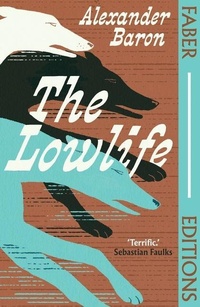
The Lowlife (Faber Editions)
'Terrific. Propulsive, funny and touching.' - Sebastian Faulks
Published on 8. May 2025
Book
Paperback/Softback
256 pages
978-0-571-39347-3 (ISBN)
Description
One man gambles on his own life in this rediscovered Jewish post-war classic of London's seedy underbelly, introduced by Iain Sinclair.
'Terrific. Propulsive, funny and touching.' Sebastian Faulks
'A fascinating snapshot of a lost London world, by a remarkable neglected writer.' Sarah Waters
A wonderfully enduring novel . . . A great rediscovery.' William Boyd
'Perfect . . . Captures London in all its grime and glory.' Benjamin Myers
Never give up hope before the dogs have crossed the finishing-line.
Harryboy Boas is a lowlife gambler. When he's not at the track, he lives in a Hackney boarding house, reading Zola, eating salt beef, pressing trousers and repressing wartime memories. But when a new family moves into the apartment downstairs, his life starts to unravel and Harryboy soon finds himself sinking into a murky East End underworld where violence, guilt and gangsters are the inevitable result for those who cannot pay their dues.
A celebrated cult classic, The Lowlife brilliantly evokes post-war East London - dog tracks, sandwich shops, tenements, sex workers, newly arrived West Indians and Jews leaving for Finchley - all seen through the tragicomic eyes of Harryboy, our picaresque rogue hero suffering from 'existential burn-out in the shadow of the Holocaust' (Iain Sinclair) and driven to bet, brag and beg to survive.
'The greatest British novelist of the last war and among the finest, most underrated, of the postwar period.' Guardian
'Terrific. Propulsive, funny and touching.' Sebastian Faulks
'A fascinating snapshot of a lost London world, by a remarkable neglected writer.' Sarah Waters
A wonderfully enduring novel . . . A great rediscovery.' William Boyd
'Perfect . . . Captures London in all its grime and glory.' Benjamin Myers
Never give up hope before the dogs have crossed the finishing-line.
Harryboy Boas is a lowlife gambler. When he's not at the track, he lives in a Hackney boarding house, reading Zola, eating salt beef, pressing trousers and repressing wartime memories. But when a new family moves into the apartment downstairs, his life starts to unravel and Harryboy soon finds himself sinking into a murky East End underworld where violence, guilt and gangsters are the inevitable result for those who cannot pay their dues.
A celebrated cult classic, The Lowlife brilliantly evokes post-war East London - dog tracks, sandwich shops, tenements, sex workers, newly arrived West Indians and Jews leaving for Finchley - all seen through the tragicomic eyes of Harryboy, our picaresque rogue hero suffering from 'existential burn-out in the shadow of the Holocaust' (Iain Sinclair) and driven to bet, brag and beg to survive.
'The greatest British novelist of the last war and among the finest, most underrated, of the postwar period.' Guardian
Reviews / Votes
'Extraordinary.', William Boyd'The wonder of The Lowlife is that it does justice to a place of so many contradictions ... One of the best fictions, the truest accounts of [Hackney]', Iain Sinclair
More details
Series
Edition
Main
Language
English
Place of publication
London
United Kingdom
Dimensions
Height: 196 mm
Width: 132 mm
Thickness: 20 mm
Weight
221 gr
ISBN-13
978-0-571-39347-3 (9780571393473)
Copyright in bibliographic data and cover images is held by Nielsen Book Services Limited or by the publishers or by their respective licensors: all rights reserved.
Schweitzer Classification
Other editions
Additional editions
Alexander Baron
The Lowlife (Faber Editions)
'Terrific. Propulsive, Funny and Touching.' - Sebastian Faulks
E-Book
05/2025
Faber & Faber
€11.99
Available for download
Persons
Alexander Baron (1917 - 1999) grew up in in Hackney. The son of Jewish parents, he was drawn into the anti-fascist struggle, confronting Mosley's blackshirts in London, before enlisting in the army in 1940 and fighting on the Normandy D-Day beaches. His experiences inspired his famous wartime trilogy as well as Hollywood screenplays and BBC adaptations.