

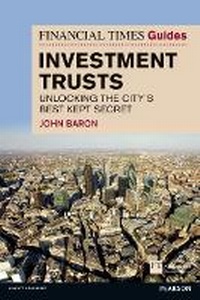
Financial Times Guide to Investment Trusts
Unlocking the City's Best Kept Secret
Published on 15. August 2013
Book
Paperback/Softback
168 pages
978-1-292-00156-2 (ISBN)
Description
A comprehensive and practical guide to investment trusts. These investment vehicles have been underused by investors in the past, but that is set to change now that the Retail Distribution Review has banned commissions and put investment trusts on a level playing field. The book explains what investment trusts are and focuses on how to construct and run a trust portfolio. It offers investors, both experienced and novice, a concise and jargon free guide to these lucrative investment vehicles.
Reviews / Votes
Investment trusts are often thought of as being "complicated" or "only for City types". John Baron shows clearly that they are neither, and can be used effectively by anyone looking to make the most of their money.Jonathan Eley, editor, FT Money
More details
Other editions
New editions
John Baron | John C. Baron
Financial Times Guide to Investment Trusts, The
Unlocking the City's Best Kept Secret
Book
08/2020
2nd Edition
FT Publishing International
€33.99
Shipment within 10-20 days
Person
John Baron has used investment trusts in both a private and professional capacity for over 30 years. On leaving the Army, he entered the City as a fund manager running a range of portfolios for private clients and charities. He was a Director of Henderson Private Clients, and then a Director of Rothschild Asset Management having been approached to run their private client core UK equity portfolio.
He is best known to readers of the FT's Investor Chronicle magazine for having successfully run two live investment trust portfolios as measured by their appropriate APCIMs Growth and Income benchmarks. He also speaks at investment seminars
On entering politics, John has sat on the other side of the fence helping charities monitor their fund managers. He remains a member of the Chartered Institute for Securities & Management.
He is best known to readers of the FT's Investor Chronicle magazine for having successfully run two live investment trust portfolios as measured by their appropriate APCIMs Growth and Income benchmarks. He also speaks at investment seminars
On entering politics, John has sat on the other side of the fence helping charities monitor their fund managers. He remains a member of the Chartered Institute for Securities & Management.
Content
Foreword
Introduction: The changing landscape
Chapter 1: Structure and scope
? What are investment trusts?
? Net asset value (NAV)
? Discounts and premiums
? Price and size
? Range and reach
Chapter 2: Better performance
? Share prices
? NAV comparison
? Clear message
? The strange case of 'Mirror funds'
Chapter3: Cheaper Fees
? Charges compared
? Effect on returns
? Lessons from America
? The TER and more
Chapter 4: Discount opportunities
? Their importance
? Factors affecting
? Judging opportunities
? The long term
Chapter 5: Other advantages
? Gearing
? Board of Directors
? Shareholder power
? Long term investing
? Marketability
? Dividends
? Capital changes
Chapter 6: The disadvantages
? Unhelpful gearing
? Widening discounts
? Poor liquidity
? Rising fees
? The result!
Chapter 7: Useful miscellany
? Directors' shareholdings
? Report & Accounts
? Doing the splits
? ETFs and trackers
? Portfolio turnover
Chapter 8: Investment objectives
? Risk tolerances
? Income requirements
? Time horizons
? Currency and other considerations
? Choosing a benchmark
Chapter 9: Successful investing
? Getting started
? Staying invested
? Diversification
? Importance of dividends
? Some other secrets!
Chapter 10: Portfolio construction
? The Investors Chronicle portfolios
? Balancing capital and income
? Themes and geography
? Risk and reward
? Some golden rules
Conclusion
Introduction: The changing landscape
Chapter 1: Structure and scope
? What are investment trusts?
? Net asset value (NAV)
? Discounts and premiums
? Price and size
? Range and reach
Chapter 2: Better performance
? Share prices
? NAV comparison
? Clear message
? The strange case of 'Mirror funds'
Chapter3: Cheaper Fees
? Charges compared
? Effect on returns
? Lessons from America
? The TER and more
Chapter 4: Discount opportunities
? Their importance
? Factors affecting
? Judging opportunities
? The long term
Chapter 5: Other advantages
? Gearing
? Board of Directors
? Shareholder power
? Long term investing
? Marketability
? Dividends
? Capital changes
Chapter 6: The disadvantages
? Unhelpful gearing
? Widening discounts
? Poor liquidity
? Rising fees
? The result!
Chapter 7: Useful miscellany
? Directors' shareholdings
? Report & Accounts
? Doing the splits
? ETFs and trackers
? Portfolio turnover
Chapter 8: Investment objectives
? Risk tolerances
? Income requirements
? Time horizons
? Currency and other considerations
? Choosing a benchmark
Chapter 9: Successful investing
? Getting started
? Staying invested
? Diversification
? Importance of dividends
? Some other secrets!
Chapter 10: Portfolio construction
? The Investors Chronicle portfolios
? Balancing capital and income
? Themes and geography
? Risk and reward
? Some golden rules
Conclusion