

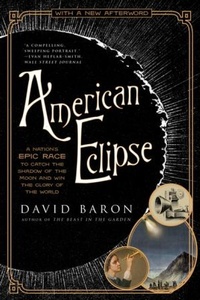
American Eclipse
A Nation's Epic Race to Catch the Shadow of the Moon and Win the Glory of the World
Published on 12. April 2024
Book
Paperback/Softback
368 pages
978-1-324-09469-2 (ISBN)
Description
On a scorching July afternoon in 1878, at the dawn of the Gilded Age, the moon's shadow descended on the American West, darkening skies from Montana Territory to Texas. This rare celestial event-a total solar eclipse-offered a priceless opportunity to solve some of the solar system's most enduring riddles, and it prompted a clutch of enterprising scientists to brave the wild frontier in a gruelling race to the Rocky Mountains. Acclaimed science journalist David Baron, long fascinated by eclipses, re-creates this epic tale of ambition, failure and glory in a narrative that reveals as much about the historical trajectory of a striving young nation as it does about those scant three minutes when the blue sky blackened and stars appeared in mid-afternoon.
In vibrant historical detail, American Eclipse animates the fierce jockeying that came to dominate late nineteenth-century American astronomy, bringing to life the challenges faced by three of the most determined eclipse chasers who participated in this adventure. James Craig Watson, virtually forgotten in the twenty-first century, was in his day a renowned asteroid hunter who fantasised about becoming a Gilded Age Galileo. Hauling a telescope, a star chart, and his long-suffering wife out west, Watson believed that he would discover Vulcan, a hypothesised "intra-Mercurial" planet hidden in the sun's brilliance. No less determined was Vassar astronomer Maria Mitchell, who-in an era when women's education came under fierce attack-fought to demonstrate that science and higher learning were not anathema to femininity. Despite obstacles erected by the male-dominated astronomical community, an indifferent government and careless porters, Mitchell courageously charged west with a contingent of female students intent on observing the transcendent phenomenon for themselves. Finally, Thomas Edison-a young inventor and irrepressible showman-braved the wilderness to prove himself to the scientific community. Armed with his newest invention, the tasimeter and pursued at each stop by throngs of reporters, Edison sought to leverage the eclipse to cement his place in history. What he learned on the frontier, in fact, would help him illuminate the world.
With memorable accounts of train robberies and Indian skirmishes, David Baron's page-turning drama refracts nineteenth-century science through the mythologised age of the Wild West, revealing a history no less fierce and fantastical.
In vibrant historical detail, American Eclipse animates the fierce jockeying that came to dominate late nineteenth-century American astronomy, bringing to life the challenges faced by three of the most determined eclipse chasers who participated in this adventure. James Craig Watson, virtually forgotten in the twenty-first century, was in his day a renowned asteroid hunter who fantasised about becoming a Gilded Age Galileo. Hauling a telescope, a star chart, and his long-suffering wife out west, Watson believed that he would discover Vulcan, a hypothesised "intra-Mercurial" planet hidden in the sun's brilliance. No less determined was Vassar astronomer Maria Mitchell, who-in an era when women's education came under fierce attack-fought to demonstrate that science and higher learning were not anathema to femininity. Despite obstacles erected by the male-dominated astronomical community, an indifferent government and careless porters, Mitchell courageously charged west with a contingent of female students intent on observing the transcendent phenomenon for themselves. Finally, Thomas Edison-a young inventor and irrepressible showman-braved the wilderness to prove himself to the scientific community. Armed with his newest invention, the tasimeter and pursued at each stop by throngs of reporters, Edison sought to leverage the eclipse to cement his place in history. What he learned on the frontier, in fact, would help him illuminate the world.
With memorable accounts of train robberies and Indian skirmishes, David Baron's page-turning drama refracts nineteenth-century science through the mythologised age of the Wild West, revealing a history no less fierce and fantastical.
Reviews / Votes
"Baron's stories are good ones, well told." -- Nature "American Eclipse is an incredibly well written work of non-fiction. It is clearly the result of considerable research and careful thought. And it tells a great story." -- Book of the Month - BBC Sky at Night "The author gives a skillful account of the scientific aims of the various teams of eclipse-watchers, from the examination of the solar corona to the more precise calculation of the Moon's orbit." -- 12 Books of Christmas - BBC Sky at NightMore details
Language
English
Place of publication
New York
United States
Product notice
Paperback (trade)
Unsewn / adhesive bound
Illustrations
8 pages of photographs; 65 illustrations; 1 map
Dimensions
Height: 213 mm
Width: 140 mm
Thickness: 17 mm
Weight
299 gr
ISBN-13
978-1-324-09469-2 (9781324094692)
Copyright in bibliographic data and cover images is held by Nielsen Book Services Limited or by the publishers or by their respective licensors: all rights reserved.
Schweitzer Classification
Other editions
Additional editions
David Baron
American Eclipse
A Nation's Epic Race to Catch the Shadow of the Moon and Win the Glory of the World
E-Book
06/2017
Liveright
€17.49
Available for download
Person
David Baron is an award-winning journalist, broadcaster, and author of The Beast in the Garden and American Eclipse. A former science correspondent for NPR, he has also written for the New York Times, Washington Post, Wall Street Journal, Los Angeles Times, Scientific American, and other publications. David recently served as the Baruch S. Blumberg NASA/Library of Congress Chair in Astrobiology, Exploration, and Scientific Innovation. He lives in Boulder, Colorado.