

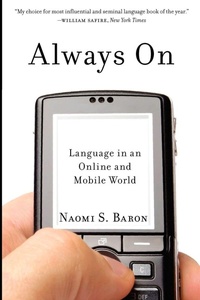
Always On
Language in an Online and Mobile World
Published on 18. March 2010
Book
Paperback/Softback
304 pages
978-0-19-973544-0 (ISBN)
Description
In Always On, Naomi S. Baron reveals that online and mobile technologies-including instant messaging, cell phones, multitasking, Facebooks, blogs, and wikis - are profoundly influencing how we read and write, speak and listen, but not in the ways we might suppose.
Baron draws on a decade of research to provide an eye-opening look at language in an online and mobile world. She reveals for instance that email, IM, and text messaging have had surprisingly little impact on student writing. Electronic media has magnified the laid-back ?whatever? attitude toward formal writing that young people everywhere have embraced, but it is not a cause of it. A more troubling trend, according to Baron, is the myriad ways in which we block incoming IMs, camouflage ourselves on Facebook, and use ring tones or caller ID to screen incoming calls on our mobile phones. Our ability to decide who to talk to, she argues, is likely to be among the most lasting influences that information technology has upon the ways we communicate with one another. Moreover, as more and more people are aelways on? one technology or another-whether communicating, working, or just surfing the web or playing games-we have to ask what kind of people do we become, as individuals and as family members or friends, if the relationships we form must increasingly compete for our attention with digital media?
Our 300-year-old written culture is on the verge of redefinition, Baron notes. It's up to us to determine how and when we use language technologies, and to weigh the personal and social benefits-and costs-of being aelways on.? This engaging and lucidly-crafted book gives us the tools for taking on these challenges.
Baron draws on a decade of research to provide an eye-opening look at language in an online and mobile world. She reveals for instance that email, IM, and text messaging have had surprisingly little impact on student writing. Electronic media has magnified the laid-back ?whatever? attitude toward formal writing that young people everywhere have embraced, but it is not a cause of it. A more troubling trend, according to Baron, is the myriad ways in which we block incoming IMs, camouflage ourselves on Facebook, and use ring tones or caller ID to screen incoming calls on our mobile phones. Our ability to decide who to talk to, she argues, is likely to be among the most lasting influences that information technology has upon the ways we communicate with one another. Moreover, as more and more people are aelways on? one technology or another-whether communicating, working, or just surfing the web or playing games-we have to ask what kind of people do we become, as individuals and as family members or friends, if the relationships we form must increasingly compete for our attention with digital media?
Our 300-year-old written culture is on the verge of redefinition, Baron notes. It's up to us to determine how and when we use language technologies, and to weigh the personal and social benefits-and costs-of being aelways on.? This engaging and lucidly-crafted book gives us the tools for taking on these challenges.
Reviews / Votes
Naomi Baron artfully combines historical surveys, research summaries, and findings of her own to give us a comprehensive, insightful, and thoughtful handbook for understanding electronic communication-what it is, how it works, and how it's changing our lives and our interpersonal relationships. * Deborah Tannen, Georgetown University, author of You Just Don't Understand and You're Wearing That? Understanding Mothers and Daughters in Conversation *More details
Language
English
Place of publication
New York
United States
Target group
Adult education
Illustrations
8 black and white halftones
Dimensions
Height: 234 mm
Width: 156 mm
Thickness: 16 mm
Weight
465 gr
ISBN-13
978-0-19-973544-0 (9780199735440)
Copyright in bibliographic data and cover images is held by Nielsen Book Services Limited or by the publishers or by their respective licensors: all rights reserved.
Schweitzer Classification
Other editions
Additional editions
E-Book
03/2010
1st Edition
Oxford University Press
€32.39
Available for download
E-Book
03/2010
1st Edition
OUP eBook
€16.49
Available for download
Book
04/2008
Oxford University Press Inc
€109.90
Shipment within 15-20 days
Person
Naomi S. Baron is Professor of Linguistics Emerita at American University in Washington, DC. A leading authority on language use in the age of the computer, she has studied instant messaging, text messaging, mobile phone practices, multitasking behavior, and Facebook usage by American college students. She is the author of six books, including Alphabet to Email: How Written English Evolved and Where It's Heading, and she has been interviewed on ?Good Morning America,? ?20/20,? Fox 5, CNN, Fresh Air, All Things Considered, Morning Edition, The New York Times, Wire Magazine, Boston Globe, Washington Post, and more.
Content
PREFACE