

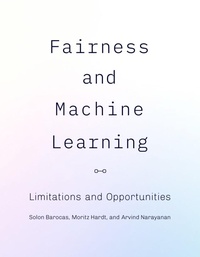
Fairness and Machine Learning
Limitations and Opportunities
Published on 19. December 2023
Book
Hardback
320 pages
978-0-262-04861-3 (ISBN)
Description
An introduction to the intellectual foundations and practical utility of the recent work on fairness and machine learning.
Fairness and Machine Learning introduces advanced undergraduate and graduate students to the intellectual foundations of this recently emergent field, drawing on a diverse range of disciplinary perspectives to identify the opportunities and hazards of automated decision-making. It surveys the risks in many applications of machine learning and provides a review of an emerging set of proposed solutions, showing how even well-intentioned applications may give rise to objectionable results. It covers the statistical and causal measures used to evaluate the fairness of machine learning models as well as the procedural and substantive aspects of decision-making that are core to debates about fairness, including a review of legal and philosophical perspectives on discrimination. This incisive textbook prepares students of machine learning to do quantitative work on fairness while reflecting critically on its foundations and its practical utility.
• Introduces the technical and normative foundations of fairness in automated decision-making
• Covers the formal and computational methods for characterizing and addressing problems
• Provides a critical assessment of their intellectual foundations and practical utility
• Features rich pedagogy and extensive instructor resources
Fairness and Machine Learning introduces advanced undergraduate and graduate students to the intellectual foundations of this recently emergent field, drawing on a diverse range of disciplinary perspectives to identify the opportunities and hazards of automated decision-making. It surveys the risks in many applications of machine learning and provides a review of an emerging set of proposed solutions, showing how even well-intentioned applications may give rise to objectionable results. It covers the statistical and causal measures used to evaluate the fairness of machine learning models as well as the procedural and substantive aspects of decision-making that are core to debates about fairness, including a review of legal and philosophical perspectives on discrimination. This incisive textbook prepares students of machine learning to do quantitative work on fairness while reflecting critically on its foundations and its practical utility.
• Introduces the technical and normative foundations of fairness in automated decision-making
• Covers the formal and computational methods for characterizing and addressing problems
• Provides a critical assessment of their intellectual foundations and practical utility
• Features rich pedagogy and extensive instructor resources
More details
Language
English
Place of publication
Cambridge (Massachusetts)
United States
Publishing group
MIT Press Ltd
Illustrations
40 BLACK AND WHITE ILLUS.
Dimensions
Height: 236 mm
Width: 185 mm
Thickness: 30 mm
Weight
788 gr
ISBN-13
978-0-262-04861-3 (9780262048613)
Copyright in bibliographic data and cover images is held by Nielsen Book Services Limited or by the publishers or by their respective licensors: all rights reserved.
Schweitzer Classification
Other editions
Additional editions
Solon Barocas | Moritz Hardt | Arvind Narayanan
Fairness and Machine Learning
Limitations and Opportunities
E-Book
12/2023
MIT Press
€63.49
Available for download
Persons
Solon Barocas, Moritz Hardt, and Arvind Narayanan
Content
Preface ix
Online Materials xiv
Acknowledgments xv
1 Introduction 1
2 When Is Automated Decision Making Legitimate? 25
3 Classification 49
4 Relative Notions of Fairness 83
5 Causality 113
6 Understanding United States Antidiscrimination Law 151
7 Testing Discrimination in Practice 185
8 A Broader View of Discrimination 221
9 Datasets 251
References 285
Index 311
Online Materials xiv
Acknowledgments xv
1 Introduction 1
2 When Is Automated Decision Making Legitimate? 25
3 Classification 49
4 Relative Notions of Fairness 83
5 Causality 113
6 Understanding United States Antidiscrimination Law 151
7 Testing Discrimination in Practice 185
8 A Broader View of Discrimination 221
9 Datasets 251
References 285
Index 311