

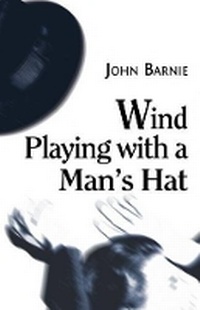
Wind Playing with a Man's Hat
Published on 10. October 2016
Book
Paperback/Softback
74 pages
978-1-910836-39-2 (ISBN)
Description
Deeply perceptive, always dipping below the surface of things, Wind Playing with a Man's Hat combines a plaintive honesty about change, mortality and darkness with a precise and lyrical vision that also sees the light. -- Cyngor Llyfrau Cymru
Reviews / Votes
Deeply perceptive, always dipping below the surface of things, Wind Playing with a Man's Hat combines a plaintive honesty about change, mortality and darkness with a precise and lyrical vision that also sees the light. Never sentimental, there is a keenness of wit that penetrates to the heart of things, the poems uncurling in single sentences that reverberate with gentle, but profound moments of epiphany:as if grain should cascade
forever in a golden trail
and all they had to do was
follow to the rainbow's end.
(Point of View)
Praise for John Barnie's Previous Work
The Roaring Boys:
'Barnie's poetry is hard to dislike, its pace, its riff being easy on the eye and ear, but he doesn't pander to the heart.'
Kym Martindale, New Welsh Review
A Year of Flowers:
'It is rare that I read a poetry volume at one sitting. But I did so with this one. Indeed, in its delicacy and wit, and in Barnie's deeply appealing pleasure in his book's subject-matter - something that radiates from it throughout - I am left wondering if A Year of Flowers might just be the best piece of work that he has given us so far.'
Matthew Jarvis, Poetry Wales -- Publisher: Cinnamon Press The title of this new poetry collection from John Barnie suggests a sense of play as well as an awareness that the 'man' in question, and humankind more generally, is subject to forces larger than himself. A number of poems focus on notions of perspective, of our smallness in the universe. In 'This, Done', though human beings might be the 'only travellers' in space, our achievement is reduced to 'making leaps to the moon/like fleas'. A moment watching jackdaws stands outside time: 'this could have been after humans or before' ('What I Saw'). Such is the brief period we occupy in the grand scheme of things; we're like the flies in 'Page 438', pressed flat in a book, as the speaker asks, 'do they/last a day, I doubt it'.
This isn't to suggest the collection is nihilistic. What emerges from the humbling of human bravado is the need to connect on a very human level, and a good number of poems focus on communication: letters, notebooks, monologues with implied addressees, posting donations to orphans in Uganda, the stuttering speech of a stroke survivor, phone calls from someone who is suicidal. As the last two items in that list hint, running through the collection is an acknowledgement of ageing and mortality. In 'Such a Fabulous Beast', the speaker experiences a disjunction between their sense of self and the face they see in the mirror which offers only 'the husk of the inner me'. A positive response is found in a cockerel who proclaims 'it is never going to die', gaining the speaker's admiration.
Whilst not shying away from loss and painful change, the poems in this collection are outward-looking, questing. An early poem, 'Forward!', quotes T. S. Eliot as an epigraph: 'Old men ought to be explorers'. This sets the tone for the book's exploratory nature - intellectually probing and concerned with actual explorers too, including Welshman Henry Morton Stanley who is the subject of a scattered sequence, his work with the Belgian King Leopold II in the Congo bringing the figures of Joseph Conrad and his character Marlow into the collection too.
These explorers are matched by Barnie's expansive development of ideas within single poems; there's an exquisite sense, often, of travelling. 'Two Brothers' is a stand-out example. What begins as a pen-portrait of the titular men becomes an exploration of the speaker's relationship with them, centring on the fact 'we've each seen Death hobbling down a country road'. That road has a Little Chef from which a waitress 'looks out bored through the window,/a Hopper girl, wondering if her chance will come'. Form helps these ideas to move. As with his 2012 collection, The Roaring Boys, Barnie's poems are composed as single sentences that run the length of each piece; the development of ideas is controlled by semi-colons. The expression contained in these linking chains is conversational, decidedly un-showy and lacking artifice, alive to rhythm and rhyme that makes the vast majority of these poems softly lyrical, as in these lines from 'Engineers': 'we'll have you/hanging there in the blue, the bright/twin of a dark star, and you'll see far/on the horizon the white ships sail/as in Conrad's day, back and forth/in the hissing spray.'
Wind Playing with a Man's Hat is a 'back and forth' sort of book, restless in the best sense. -- Katherine Stansfield @ www.gwales.com
More details
Language
English
Place of publication
Blaenau Ffestiniog
United Kingdom
Dimensions
Height: 216 mm
Width: 140 mm
ISBN-13
978-1-910836-39-2 (9781910836392)
Copyright in bibliographic data and cover images is held by Nielsen Book Services Limited or by the publishers or by their respective licensors: all rights reserved.
Schweitzer Classification
Person
John Barnie is a poet and essayist from Abergavenny, Gwent. John ived in Denmark from 1969-1982 and was the editor of Planet, The Welsh Internationalist from 1990-2006. He has published several collections of poems, mixed poems and fiction, and two collections of essays, one of which, The King of Ashes, won a Welsh Arts Council Prize for Literature in 1990. His collection Trouble in Heaven (Gomer, 2007) was on the Wales Book of the Year 2008 Long List. Cinnamon Press has published fivve of his collections: The Forest Under the Sea, The Roaring Boys, Wind Playing with a Man's Hat, Departure Lounge and 2020's Sunglasses. John also plays guitar in the blues and poetry group Hollow Log. He is a Fellow of Yr Academi.