

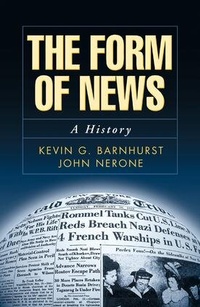
The Form of News
A History
1st Edition
Published on 25. July 2002
Book
Paperback/Softback
326 pages
978-1-57230-791-9 (ISBN)
Description
This book takes a fresh look at the role of the newspaper in United States civic culture. Unlike other histories which focus only on the content of newspapers, this book digs deeper into ways of writing, systems of organizing content, and genres of presentation, including typography and pictures. The authors examine how these elements have combined to give newspapers a distinctive look at every historical moment, from the colonial to the digital eras. They reveal how the changing form of news reflects such major social forces as the rise of mass politics, the industrial revolution, the growth of the market economy, the course of modernism, and the emergence of the Internet. Whether serving as town meeting, court of opinion, marketplace, social map, or catalog of diversions, news forms are also shown to embody cultural authority, allowing readers to see and relate to the world from a particular perspective. Including over 70 illustrations, the book explores such compelling themes as the role of news in a democratic society, the relationship between news and visual culture, and the ways newspapers have shaped the meaning of citizenship.
Winner of the International Communication Association Outstanding Book Award
Winner of the International Communication Association Outstanding Book Award
Reviews / Votes
This wonderfully intelligent book is an innovative rewriting of journalism history through the prism of newspaper design. It will enlarge and deepen our view of the press and will strengthen our understanding of the relation between journalism and civic life. --James Carey, Columbia UniversityThe Form of News is the best--that is, the most well-written, comprehensive, and cogent--text to date on the history of newspapers in America. It will be useful for undergraduate and graduate courses, and will be of considerable interest to general readers.--Neil M. Postman, New York University
A marvelous book. Barnhurst and Nerone's thesis that news forms have a powerful impact on the civic culture is a compelling argument that gains force from their careful research and analysis. This book should be included in the required reading list of any graduate or upper-division newspaper course. Sprinkled with insights and historical examples, The Form of News is a 'must' read for all serious students of the media--scholars and journalists alike. --Thomas E. Patterson, Bradlee Professor of Government & the Press, Harvard University
- Two enterprising scholars and newspaper buffs offer here an original new frame for American journalism history by analyzing the changing appearance of newspapers. --Columbia Journalism Review, 5/5/2002?? Offers a useful and accessible overview of the history of American newspaper form. Ideally, [this book] will also serve as a baseline and model for future studies analyzing the relationship between form and the role a medium plays in society. --SHARP News (Society for the History of Authorship, Reading and Publishing), 5/5/2002?? Barnhurst and Nerone cover ground that has rarely been tread before. And they do it with a keen eye on historical context. --Nieman Reports, 5/5/2002
More details
Series
Language
English
Place of publication
New York
United States
Target group
College/higher education
Professional and scholarly
General, Postgraduate, Professional Practice & Development, and Undergraduate
Dimensions
Height: 234 mm
Width: 156 mm
Weight
460 gr
ISBN-13
978-1-57230-791-9 (9781572307919)
Copyright in bibliographic data and cover images is held by Nielsen Book Services Limited or by the publishers or by their respective licensors: all rights reserved.
Schweitzer Classification
Other editions
Additional editions
Book
05/2001
1st Edition
Guilford Publications
€85.60
Article exhausted; check different version
Persons
Kevin G. Barnhurst grew up in Salt Lake City and received a PhD (1997) from the University of Amsterdam. Before joining the communication faculty at the University of Illinois at Chicago, he was a Fulbright professor in Lima, Peru; completed a research fellowship at Columbia University; and taught journalism and graphic design. His first book, Seeing the Newspaper, was named a Best Book of 1994 by In These Times magazine, and he has written for the Christian Science Monitor, the Chicago Tribune, Commentary, and the American Scholar.
John Nerone was born in Cincinnati and educated at Xavier University and the University of Notre Dame, where he received a PhD (1982). In 1983 he began teaching in the College of Communications, University of Illinois at Urbana-Champaign, where he continues to teach courses in the history of the media and normative press theory. He is the author of three previous books: The Culture of the Press in the Early Republic, Violence against the Press, and Last Rights: Revisiting Four Theories of the Press, which he edited and coauthored with seven of his colleagues in Urbana.
John Nerone was born in Cincinnati and educated at Xavier University and the University of Notre Dame, where he received a PhD (1982). In 1983 he began teaching in the College of Communications, University of Illinois at Urbana-Champaign, where he continues to teach courses in the history of the media and normative press theory. He is the author of three previous books: The Culture of the Press in the Early Republic, Violence against the Press, and Last Rights: Revisiting Four Theories of the Press, which he edited and coauthored with seven of his colleagues in Urbana.
Content
Chapter 1. The Form of News: Style, Production, and Social Meaning, 1750-2000
Part I. Before Modernism
Chapter 2. The Founding Forms: Politics and the Work of Newspapers, 1750-1850
Chapter 3. Commercialization: The Newspaper and the Market Revolution, 1780s-1880s
Part II. The Role of Pictures
Chapter 4. Civic Picturing: The Regime of Illustrated News, 1856-1901
Chapter 5. The President Is Dead: Pictures and Journalistic Values, 1881-1963
Part III. The Rise of Modernism
Chapter 6. The Front Page: Measuring Modernism and Its Phases, 1885-1985
Chapter 7. Visual Mapping: Modern Design and Cultural Authority, 1920-1940
Part IV. After Modernism
Chapter 8. Beyond Modernism: Americanization and Its Consequences, 1910-2000
Chapter 9. Spectators and Their Spectacles: Forms of Knowledge, Forms of Power
References
Index
Part I. Before Modernism
Chapter 2. The Founding Forms: Politics and the Work of Newspapers, 1750-1850
Chapter 3. Commercialization: The Newspaper and the Market Revolution, 1780s-1880s
Part II. The Role of Pictures
Chapter 4. Civic Picturing: The Regime of Illustrated News, 1856-1901
Chapter 5. The President Is Dead: Pictures and Journalistic Values, 1881-1963
Part III. The Rise of Modernism
Chapter 6. The Front Page: Measuring Modernism and Its Phases, 1885-1985
Chapter 7. Visual Mapping: Modern Design and Cultural Authority, 1920-1940
Part IV. After Modernism
Chapter 8. Beyond Modernism: Americanization and Its Consequences, 1910-2000
Chapter 9. Spectators and Their Spectacles: Forms of Knowledge, Forms of Power
References
Index