

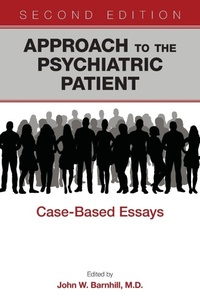
Approach to the Psychiatric Patient
Case-Based Essays
2nd Edition
Published on 20. January 2019
Book
Paperback/Softback
616 pages
978-1-61537-002-3 (ISBN)
Description
A fascinating text that addresses the clinical and
educational challenges of treating psychiatric patients from a truly
multidisciplinary perspective using a case-based format, Approach to the
Psychiatric Patient: Case-Based Essays is the only book of its kind
and an indispensable addition to the mental health practitioner's library.
The new edition builds upon the strengths that distinguished the first, with
composite cases that are carefully constructed to capture real-world
problems, followed by essays that provide clear and cogent perspectives on
the case. These essays cover a wide range, from the more conventional (such
as differential diagnosis of anxiety or the clinical characteristics of
delirium) to the unusual and intriguing (such as creativity and mental
illness or an analysis of the case in relation to the classic, Strange
Case of Dr. Jekyll and Mr. Hyde). Every chapter has been revised,
and the book boasts many new co-contributors, as well as the addition of
completely new essays. For example, in the chapter on geriatric depression,
several new essays have been added on the topics of collaborative care and
the embedded psychiatrist, depression and medical illness, and biomarkers to
identify depression subtypes, while the chapter on terminal illness features
new essays on spirituality and meaning-centered therapy. In addition, there
are new essays on co-occurring anxiety and alcohol use disorders, medication
assisted treatment for stimulant use, treatment of body dysmorphic disorder,
and more.
The text possesses many useful attributes for the reader:
* The more than 100 essays were written by a broad range of
specialists, each with particular expertise in their aspect of the case, and
the resulting commentary is focused and concise.
* In addition to the
case and discussions, each chapter offers an overview and summary points
designed to facilitate further consideration of the patient and clinical
situation and to focus on the key points.
* The book's unique structure
enhances its flexibility, allowing the reader to read a case and
accompanying essays straight through, or to pick and choose as the need or
whim arises.
* The cases' clinical settings are diverse, ranging from
inpatient hospitalizations and emergency room evaluations to outpatient
assessments and long-term psychotherapies, maximizing relevance and
resonance.
* Each essay has its own bibliography, which provides both
rigorous documentation and additional sources for more exploration of the
topic.
Approach to the Psychiatric Patient: Case-Based Essays
distinguishes itself from prior texts in both the richness of its cases and
the ingenuity of its format, and its multidisciplinary wisdom and insight
will be appreciated by a wide range of readers.
educational challenges of treating psychiatric patients from a truly
multidisciplinary perspective using a case-based format, Approach to the
Psychiatric Patient: Case-Based Essays is the only book of its kind
and an indispensable addition to the mental health practitioner's library.
The new edition builds upon the strengths that distinguished the first, with
composite cases that are carefully constructed to capture real-world
problems, followed by essays that provide clear and cogent perspectives on
the case. These essays cover a wide range, from the more conventional (such
as differential diagnosis of anxiety or the clinical characteristics of
delirium) to the unusual and intriguing (such as creativity and mental
illness or an analysis of the case in relation to the classic, Strange
Case of Dr. Jekyll and Mr. Hyde). Every chapter has been revised,
and the book boasts many new co-contributors, as well as the addition of
completely new essays. For example, in the chapter on geriatric depression,
several new essays have been added on the topics of collaborative care and
the embedded psychiatrist, depression and medical illness, and biomarkers to
identify depression subtypes, while the chapter on terminal illness features
new essays on spirituality and meaning-centered therapy. In addition, there
are new essays on co-occurring anxiety and alcohol use disorders, medication
assisted treatment for stimulant use, treatment of body dysmorphic disorder,
and more.
The text possesses many useful attributes for the reader:
* The more than 100 essays were written by a broad range of
specialists, each with particular expertise in their aspect of the case, and
the resulting commentary is focused and concise.
* In addition to the
case and discussions, each chapter offers an overview and summary points
designed to facilitate further consideration of the patient and clinical
situation and to focus on the key points.
* The book's unique structure
enhances its flexibility, allowing the reader to read a case and
accompanying essays straight through, or to pick and choose as the need or
whim arises.
* The cases' clinical settings are diverse, ranging from
inpatient hospitalizations and emergency room evaluations to outpatient
assessments and long-term psychotherapies, maximizing relevance and
resonance.
* Each essay has its own bibliography, which provides both
rigorous documentation and additional sources for more exploration of the
topic.
Approach to the Psychiatric Patient: Case-Based Essays
distinguishes itself from prior texts in both the richness of its cases and
the ingenuity of its format, and its multidisciplinary wisdom and insight
will be appreciated by a wide range of readers.
Reviews / Votes
This is an excellent book. The variety of angles andviewpoints is fresh and informative, and I see it as a valuable adjunct to
my education as a psychiatric resident. I appreciate the nuance of the
essays given their readability, which keeps the book from becoming dry. It
functions as an outstanding introduction to the thoughtfulness and
premeditation that providers in the field of psychiatry ought to possess.
This updated edition reflects the changes in the DSM-5 as well as other
research, which keeps the content relevant. The core message of the book,
however, is not necessarily dependent on perfectly reflecting current
theory. Rather, the book focuses on pushing readers to keep an open mind
through informative and sophisticated discussion, a goal that is achieved in
spades. -- Jason Andreas, D.O. * Doody's Book Reviews *
More details
Edition
Second Edition
Language
English
Place of publication
VA
United States
Target group
Professional and scholarly
US School Grade: College Graduate Student and over
Edition type
Revised edition
Product notice
Paperback (trade)
Illustrations
12 Figures; 9 Tables, unspecified
Dimensions
Height: 229 mm
Width: 152 mm
Thickness: 32 mm
Weight
816 gr
ISBN-13
978-1-61537-002-3 (9781615370023)
Copyright in bibliographic data and cover images is held by Nielsen Book Services Limited or by the publishers or by their respective licensors: all rights reserved.
Schweitzer Classification
Other editions
Additional editions
E-Book
11/2018
2nd Edition
American Psychiatric Association Publishing
€61.49
Available for download
Previous edition
Book
08/2008
American Psychiatric Association Publishing
€95.52
Article exhausted; check for reprint
Person
John W. Barnhill, M.D., is Professor of Clinical
Psychiatry and Professor of Medical Ethics in Clinical Medicine, DeWitt
Wallace Senior Scholar, and Vice Chair for Consultation-Liaison Psychiatry
at New York-Presbyterian Hospital/Weill Cornell Medicine.
Psychiatry and Professor of Medical Ethics in Clinical Medicine, DeWitt
Wallace Senior Scholar, and Vice Chair for Consultation-Liaison Psychiatry
at New York-Presbyterian Hospital/Weill Cornell Medicine.
Content
Contributors
Preface
How to Use This
Book
Chapter 1. Double Depression and James Avery
Chapter 2.
Geriatric Depression and Peter Burke
Chapter 3. Mood Instability and Amy
Cahill
Chapter 4. Schizophrenia and Anthony Da Piazza
Chapter 5.
Terminal Illness and Dorothy Ewing
Chapter 6. Agitation and Stephen
Franken
Chapter 7. Adolescent Bereavement and Amelia
Gutierrez
Chapter 8. Anxiety and Sophia Hastings
Chapter 9.
Hypomania and Jennifer Ingram
Chapter 10. Exam Failure and Grace
Jin
Bibliography
Subject Index
Index of Cases by Diagnostic
Concepts
Preface
How to Use This
Book
Chapter 1. Double Depression and James Avery
Chapter 2.
Geriatric Depression and Peter Burke
Chapter 3. Mood Instability and Amy
Cahill
Chapter 4. Schizophrenia and Anthony Da Piazza
Chapter 5.
Terminal Illness and Dorothy Ewing
Chapter 6. Agitation and Stephen
Franken
Chapter 7. Adolescent Bereavement and Amelia
Gutierrez
Chapter 8. Anxiety and Sophia Hastings
Chapter 9.
Hypomania and Jennifer Ingram
Chapter 10. Exam Failure and Grace
Jin
Bibliography
Subject Index
Index of Cases by Diagnostic
Concepts