

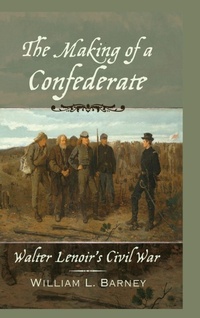
The Making of a Confederate
Walter Lenoir's Civil War
Published on 22. November 2007
Book
Hardback
272 pages
978-0-19-531435-9 (ISBN)
Description
For all the advances of the civil rights movement, and for all the cultural diversity attending economic prosperity, many white southerners have been unable to relinquish the Confederate past and the idea of a heroic, liberty-loving South crushed by power-hungry Yankees. The Making of a Confederate uses the life of one man--Walter Lenoir of North Carolina--to explore the origins of southern white identity and the myriad ambiguities and complexities embedded in that history.
Lenoir's case is particularly fascinating in the way it complicates notions about the sources of rabid devotion to the Confederate cause. Although born into a wealthy slaveholding family, Lenoir acknowledged the institution's evils and intended to divest himself of his inherited slaves. Opposed to secession, he planned in 1860 to move to Minnesota in the free North. With the war's outbreak, however, everything changed. Lenoir joined the Confederate army and fervidly supported its cause to the end. His postwar career reveals how one Confederate coped with bereavement and a crushing sense of loss, as he refashioned his memory of what had caused the war and embraced the cult of the Lost Cause. And while some southerners sank into depression, sought accommodation with the victors, or opposed the new order through various means, Lenoir found a fresh purpose by withdrawing to his acreage in the North Carolina mountains to pursue his own vision of the South's future, one that called for greater self-sufficiency and a more efficient use of the land.
For Walter Lenoir and many other Confederates, the war never really ended. In tracing this compelling story, William Barney offers new insight into the uses of memory and how individual choices transform abstract historical processes into concrete actions.
Lenoir's case is particularly fascinating in the way it complicates notions about the sources of rabid devotion to the Confederate cause. Although born into a wealthy slaveholding family, Lenoir acknowledged the institution's evils and intended to divest himself of his inherited slaves. Opposed to secession, he planned in 1860 to move to Minnesota in the free North. With the war's outbreak, however, everything changed. Lenoir joined the Confederate army and fervidly supported its cause to the end. His postwar career reveals how one Confederate coped with bereavement and a crushing sense of loss, as he refashioned his memory of what had caused the war and embraced the cult of the Lost Cause. And while some southerners sank into depression, sought accommodation with the victors, or opposed the new order through various means, Lenoir found a fresh purpose by withdrawing to his acreage in the North Carolina mountains to pursue his own vision of the South's future, one that called for greater self-sufficiency and a more efficient use of the land.
For Walter Lenoir and many other Confederates, the war never really ended. In tracing this compelling story, William Barney offers new insight into the uses of memory and how individual choices transform abstract historical processes into concrete actions.
Reviews / Votes
"In this fascinating and beautifully written portrait...William L. Barney breathes life into many key aspects of the Civil War era as it was experienced in the Upper South. A major achievement."--Bruce Levine, University of Illinois at Urbana-Champaign, author of Confederate Emancipation: Southern Plans to Free and Arm Slaves during the Civil War"An enormously intelligent, sensitive, interesting, [and] significant biography of a minor character that takes us inside one white Southerner's life, family, and mind."--Mina Carson, Oregon State University
"[An] excellent biography of Walter Lenoir [that] illustrates the dynamics of Lost Cause mythologizing in the postbellum South."--South Atlantic Review
More details
Series
Language
English
Place of publication
New York
United States
Target group
Adult education
Illustrations
25 b/w halftones, 5 line illus.
Dimensions
Height: 235 mm
Width: 157 mm
Thickness: 19 mm
Weight
535 gr
ISBN-13
978-0-19-531435-9 (9780195314359)
Copyright in bibliographic data and cover images is held by Nielsen Book Services Limited or by the publishers or by their respective licensors: all rights reserved.
Schweitzer Classification
Other editions
Additional editions
Book
06/2008
Oxford University Press Inc
€26.50
Shipment within 15-20 days
E-Book
11/2007
1st Edition
OUP eBook
€11.99
Available for download
E-Book
11/2007
1st Edition
OUP eBook
€11.99
Available for download
Person
William L. Barney is Professor of History at the University of North Carolina at Chapel Hill. His books include The Road to Secession, The Secessionist Impulse, Flawed Victory, Battleground for the Union, and The Passage of the Republic.
Content
ILLUSTRATIONS ; FOREWORD ; ACKNOWLEDGEMENTS ; THE LENOIR FAMILIES ; Prologue ; One Dutiful Sons and a Wavering Southerner ; Two Confederate Soldier ; Three Agony at Ox Hill ; Four Mountain Farmer ; Five Unreconstructed Confederate ; Six Land Promoter and Dreamer ; AFTERWORD ; RECOMMENDATIONS FOR FURTHER READING ; INDEX