

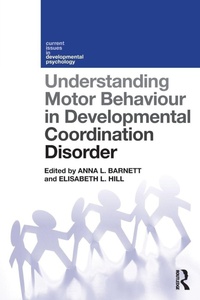
Understanding Motor Behaviour in Developmental Coordination Disorder
1st Edition
Published on 1. April 2019
Book
Paperback/Softback
194 pages
978-1-138-28757-0 (ISBN)
Description
Although Developmental Coordination Disorder (DCD, sometimes referred to as 'Dyspraxia') has received less attention than other developmental disorders, its impact can be severe and long-lasting. This volume takes a unique approach, pairing companion chapters from international experts in motor behaviour with experts in DCD. Current understanding of the motor aspects of DCD are thus considered in the context of general motor behaviour research.
Understanding Motor Behaviour in Developmental Coordination Disorder offers an overview of theoretical and methodological issues relating to motor development, motor control and skill acquisition, genetics, physical education and occupational therapy. Critically, Barnett and Hill ground DCD research within what is known about motor behaviour and typical development, allowing readers to evaluate the nature and extent of work on DCD and to identify areas for future research.
This unique approach makes the book invaluable for students in developmental psychology, clinical psychology, movement science, physiotherapy, physical education, and special education, as well as researchers and professionals working in those fields.
Understanding Motor Behaviour in Developmental Coordination Disorder offers an overview of theoretical and methodological issues relating to motor development, motor control and skill acquisition, genetics, physical education and occupational therapy. Critically, Barnett and Hill ground DCD research within what is known about motor behaviour and typical development, allowing readers to evaluate the nature and extent of work on DCD and to identify areas for future research.
This unique approach makes the book invaluable for students in developmental psychology, clinical psychology, movement science, physiotherapy, physical education, and special education, as well as researchers and professionals working in those fields.
More details
Series
Language
English
Place of publication
London
United Kingdom
Publishing group
Taylor & Francis Ltd
Target group
College/higher education
Illustrations
8 s/w Abbildungen, 4 s/w Zeichnungen, 13 s/w Tabellen
13 Tables, black and white; 4 Line drawings, black and white; 8 Illustrations, black and white
Dimensions
Height: 234 mm
Width: 156 mm
Thickness: 11 mm
Weight
324 gr
ISBN-13
978-1-138-28757-0 (9781138287570)
Copyright in bibliographic data and cover images is held by Nielsen Book Services Limited or by the publishers or by their respective licensors: all rights reserved.
Schweitzer Classification
Other editions
Additional editions
Anna Barnett | Elisabeth Hill
Understanding Motor Behaviour in Developmental Coordination Disorder
Book
04/2019
1st Edition
Routledge
€206.10
Shipment within 10-20 days
Anna Barnett | Elisabeth Hill
Understanding Motor Behaviour in Developmental Coordination Disorder
E-Book
03/2019
Routledge
€54.99
Available for download
Anna Barnett | Elisabeth Hill
Understanding Motor Behaviour in Developmental Coordination Disorder
E-Book
03/2019
1st Edition
Routledge
€55.49
Available for download
Persons
Anna L. Barnett is Professor of Psychology at Oxford Brookes University. Her general area of interest is perceptual-motor development, which focuses on various aspects of DCD - including diagnosis and assessment in children and adults with this condition.
Elisabeth L. Hill is Professor of Neurodevelopmental Disorders at Goldsmiths, University of London. Her research focuses primarily on DCD and the relationship between social and motor development in typical and atypical populations.
Elisabeth L. Hill is Professor of Neurodevelopmental Disorders at Goldsmiths, University of London. Her research focuses primarily on DCD and the relationship between social and motor development in typical and atypical populations.
Content
Section One: Development and Skill Acquisition
1. The synergetic, probabilistic pathways of typical motor development
2. Developmental progression in DCD
3. Movement Coordination, Control and Skill Development
4. Movement Coordination, Control and Skill Acquisition in DCD
Section Two: Biological aspects of development
5. Genetic contributions to neurodevelopmental disorders
6. Biological and genetic factors in DCD
Section Three: Education and therapy
7. Adapted physical activity in physical education
8. Physical education and activity in children and adolescents with DCD
9. Occupational therapy: current approaches
10. Occupational therapy for children with DCD
1. The synergetic, probabilistic pathways of typical motor development
2. Developmental progression in DCD
3. Movement Coordination, Control and Skill Development
4. Movement Coordination, Control and Skill Acquisition in DCD
Section Two: Biological aspects of development
5. Genetic contributions to neurodevelopmental disorders
6. Biological and genetic factors in DCD
Section Three: Education and therapy
7. Adapted physical activity in physical education
8. Physical education and activity in children and adolescents with DCD
9. Occupational therapy: current approaches
10. Occupational therapy for children with DCD