

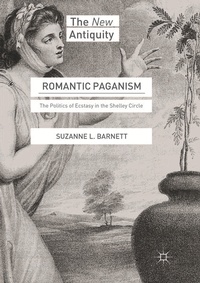
Romantic Paganism
The Politics of Ecstasy in the Shelley Circle
Published on 6. June 2019
Book
Paperback/Softback
XIII, 305 pages
978-3-319-85463-2 (ISBN)
Description
This book addresses the function of the classical world in the cultural imaginations of the second generation of romantic writers: Percy Shelley, Mary Shelley, Thomas Love Peacock, John Keats, Leigh Hunt, and the rest of their diverse circle. The younger romantics inherited impressions of the ancient world colored by the previous century, in which classical studies experienced a resurgence, the emerging field of comparative mythography investigated the relationship between Christianity and its predecessors, and scientific and archaeological discoveries began to shed unprecedented light on the ancient world. The Shelley circle embraced a specifically pagan ancient world of excess, joy, and ecstatic experiences that test the boundaries between self and other. Though dubbed the "Satanic School" by Robert Southey, this circle instead thought of itself as "Athenian" and frequently employed mythology and imagery from the classical world that was characterized not by philosophy and reason butby wildness, excess, and ecstatic experiences.
More details
Series
Edition
Softcover reprint of the original 1st ed. 2017
Language
English
Place of publication
Cham
Switzerland
Publishing group
Springer International Publishing
Target group
Professional and scholarly
Illustrations
3 s/w Abbildungen
XIII, 305 p. 3 illus.
Dimensions
Height: 210 mm
Width: 148 mm
Thickness: 18 mm
Weight
416 gr
ISBN-13
978-3-319-85463-2 (9783319854632)
DOI
10.1007/978-3-319-54723-7
Schweitzer Classification
Other editions
Additional editions
Book
02/2018
Palgrave Macmillan
€117.69
Shipment within 10-15 days
Person
Suzanne L. Barnett is Assistant Professor of English at Francis Marion University in South Carolina, USA.
Content
Acknowledgements.- List of Figures.- List of Abbreviations.- Introduction: Pretty Paganisms and Satanic Schools.- 1. "The wrecks of the Greek mythology": Paganism, Popishness, Atheism, and Decadence in the Eighteenth Century.- 2. "Cheerfulness and a sense of justice": Dionysus, Nympholepsy, and the Religion of Joy.- 3. "Prattling about Greece and Rome": Paganism, Presumption, and Gender.- 4. "The great God Pan is alive again": Peacock and Shelley in Marlow.- 5. Shelley's "Perpetual Orphic Song": Music as Pagan Ideology in
Prometheus Unbound
.- 6. Afterword: The Afterlives of Romantic Paganism.- Bibliography.- Index.