

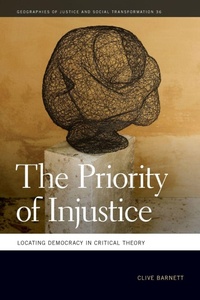
The Priority of Injustice
Locating Democracy in Critical Theory
Published on 1. November 2017
Book
Paperback/Softback
366 pages
978-0-8203-5152-0 (ISBN)
Description
This original and ambitious work looks anew at a series of intellectual debates about the meaning of democracy. Clive Barnett engages with key thinkers in various traditions of democratic theory and demonstrates the importance of a geographical imagination in interpreting contemporary political change.
Debates about radical democracy, Barnett argues, have become trapped around a set of oppositions between deliberative and agonistic theories-contrasting thinkers who promote the possibility of rational agreement and those who seek to unmask the role of power or violence or difference in shaping human affairs. While these debates are often framed in terms of consensus versus contestation, Barnett unpacks the assumptions about space and time that underlie different understandings of the sources of political conflict and shows how these differences reflect deeper philosophical commitments to theories of creative action or revived ontologies of "the political." Rather than developing ideal theories of democracy or models of proper politics, he argues that attention should turn toward the practices of claims-making through which political movements express experiences of injustice and make demands for recognition, redress, and re pair. By rethinking the spatial grammar of discussions of public space, democratic inclusion, and globalization, Barnett develops a conceptual framework for analyzing the crucial roles played by geographical processes in generating and processing contentious politics.
Debates about radical democracy, Barnett argues, have become trapped around a set of oppositions between deliberative and agonistic theories-contrasting thinkers who promote the possibility of rational agreement and those who seek to unmask the role of power or violence or difference in shaping human affairs. While these debates are often framed in terms of consensus versus contestation, Barnett unpacks the assumptions about space and time that underlie different understandings of the sources of political conflict and shows how these differences reflect deeper philosophical commitments to theories of creative action or revived ontologies of "the political." Rather than developing ideal theories of democracy or models of proper politics, he argues that attention should turn toward the practices of claims-making through which political movements express experiences of injustice and make demands for recognition, redress, and re pair. By rethinking the spatial grammar of discussions of public space, democratic inclusion, and globalization, Barnett develops a conceptual framework for analyzing the crucial roles played by geographical processes in generating and processing contentious politics.
Reviews / Votes
The Priority of Injustice is an ambitious, thoughtful, and insightful book. . . a must read for students and scholars tackling theoretical and empirical questions concerning global processes that articulate systems and institutions of injustice. -- Michael Samers * AGG Book Review Forum *More details
Series
Language
English
Place of publication
Georgia
United States
Target group
Professional and scholarly
Product notice
Paperback (trade)
Dimensions
Height: 229 mm
Width: 152 mm
Thickness: 22 mm
Weight
597 gr
ISBN-13
978-0-8203-5152-0 (9780820351520)
Copyright in bibliographic data and cover images is held by Nielsen Book Services Limited or by the publishers or by their respective licensors: all rights reserved.
Schweitzer Classification
Other editions
Additional editions
E-Book
11/2017
University of Georgia Press
€96.99
Available for download
Person
CLIVE BARNETT is a professor of geography and social theory at the University of Exeter. His books include Culture and Democracy: Media, Space, and Representation and Globalizing Responsibility: The Political Rationalities of Ethical Consumption (coauthored with Paul Cloke, Nick Clarke, and Alice Malpass).