

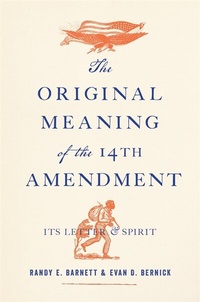
The Original Meaning of the Fourteenth Amendment
Its Letter and Spirit
Published on 2. November 2021
Book
Hardback
488 pages
978-0-674-25776-4 (ISBN)
Description
A renowned constitutional scholar and a rising star provide a balanced and definitive analysis of the origins and original meaning of the Fourteenth Amendment.
Adopted in 1868, the Fourteenth Amendment profoundly changed the Constitution, giving the federal judiciary and Congress new powers to protect the fundamental rights of individuals from being violated by the states. Yet, according to Randy Barnett and Evan Bernick, the Supreme Court has long misunderstood or ignored the original meaning of the amendment's key clauses, covering the privileges and immunities of citizenship, due process of law, and the equal protection of the laws.
Barnett and Bernick contend that the Fourteenth Amendment was the culmination of decades of debates about the meaning of the antebellum Constitution. Antislavery advocates advanced arguments informed by natural rights, the Declaration of Independence, and the common law. They also utilized what is today called public-meaning originalism. Although their arguments lost in the courts, the Republican Party was formed to advance an antislavery political agenda, eventually bringing about abolition. Then, when abolition alone proved insufficient to thwart Southern repression and provide for civil equality, the Fourteenth Amendment was enacted. It went beyond abolition to enshrine in the Constitution the concept of Republican citizenship and granted Congress power to protect fundamental rights and ensure equality before the law. Finally, Congress used its powers to pass Reconstruction-era civil rights laws that tell us much about the original scope of the amendment.
With evenhanded attention to primary sources, The Original Meaning of the Fourteenth Amendment shows how the principles of the Declaration eventually came to modify the Constitution and proposes workable doctrines for implementing the key provisions of Section 1 of the Fourteenth Amendment.
Adopted in 1868, the Fourteenth Amendment profoundly changed the Constitution, giving the federal judiciary and Congress new powers to protect the fundamental rights of individuals from being violated by the states. Yet, according to Randy Barnett and Evan Bernick, the Supreme Court has long misunderstood or ignored the original meaning of the amendment's key clauses, covering the privileges and immunities of citizenship, due process of law, and the equal protection of the laws.
Barnett and Bernick contend that the Fourteenth Amendment was the culmination of decades of debates about the meaning of the antebellum Constitution. Antislavery advocates advanced arguments informed by natural rights, the Declaration of Independence, and the common law. They also utilized what is today called public-meaning originalism. Although their arguments lost in the courts, the Republican Party was formed to advance an antislavery political agenda, eventually bringing about abolition. Then, when abolition alone proved insufficient to thwart Southern repression and provide for civil equality, the Fourteenth Amendment was enacted. It went beyond abolition to enshrine in the Constitution the concept of Republican citizenship and granted Congress power to protect fundamental rights and ensure equality before the law. Finally, Congress used its powers to pass Reconstruction-era civil rights laws that tell us much about the original scope of the amendment.
With evenhanded attention to primary sources, The Original Meaning of the Fourteenth Amendment shows how the principles of the Declaration eventually came to modify the Constitution and proposes workable doctrines for implementing the key provisions of Section 1 of the Fourteenth Amendment.
Reviews / Votes
The book's impressive array of historical materials makes an important contribution to our understanding of the 14th Amendment. -- Raymond Kethledge * Wall Street Journal * By any standard an important contribution to the ongoing discussion of the subject...[A] must-read. -- Earl M. Maltz * National Review * A major contribution to our understanding of what many consider the single most important amendment to the Constitution. It may well reshape our understanding of the Fourteenth Amendment. -- Ilya Somin * Volokh Conspiracy * The most detailed legal history to date of the constitutional amendment that changed American law more than any before or since...The corpus of legal scholarship is richer for it. * Washington Examiner * As complete an account of the intellectual and political origins of the Fourteenth Amendment as one could hope for. As a work of history, it bristles with surprises. As a contribution to constitutional theory, it poses challenging new questions for both originalists and nonoriginalists. -- Richard H. Fallon Jr., author of <i>Law and Legitimacy in the Supreme Court</i> Evincing the highest academic values of openness, integrity, and truth-seeking, this book reflects a systematic and even-handed consideration of the origins and original meaning of the Fourteenth Amendment, one of the most vital subjects in constitutional law. The definitive treatment of the subject for years and decades to come. -- Saikrishna Bangalore Prakash, author of <i>The Living Presidency</i> Provides fresh and interesting-and sometimes surprising-arguments about how best to interpret the Fourteenth Amendment. A major theme of the book is that both liberal and conservative judges have been significantly mistaken in their interpretations of the amendment. This book is designed to set them straight and to provide guidance for new and better interpretations. A truly excellent and challenging analysis of the historical record. -- Sanford V. Levinson, author of <i>Framed: America's 51 Constitutions and the Crisis of Governance</i> An outstanding account of the original public meaning of the Fourteenth Amendment's most important provisions. Comprehensive and clear, methodical and elegantly written, this work shines new light on the meaning and spirit of the Reconstruction Framers' work. Anyone who wants to understand the Fourteenth Amendment-one of the great achievements of American constitutionalism-should consult this book. -- Jack M. Balkin, Yale Law School Antislavery constitutionalism meets modern originalism in this sweeping reading of the original public meaning of the Fourteenth Amendment. Engaging for critics and adherents of originalism alike, this inventive fusion of history and constitutional theory catapults Republican antislavery to the forefront of today's rights disputes. -- Pamela Brandwein, author of <i>Rethinking the Judicial Settlement of Reconstruction</i> The Fourteenth Amendment, by far the longest of the momentous Reconstruction Amendments, is a landmark in the continuing struggle for racial equality in America, but its importance hardly ends there. Its political as well as legal origins, meanwhile, carry profound significance for the history of race, citizenship, the US Constitution, and much more. In this breakthrough book, Barnett and Bernick brilliantly explore the amendment's origins while grappling with its original meaning, in ways that will command attention from historians as well as legal scholars and constitutional lawyers. -- Sean Wilentz, author of <i>No Property in Man</i> Offer[s] a theory of interpretation that draws upon the public historical meaning of the amendment-a theory that challenges the incorrect paths the Supreme Court has taken...The strength of their argument is to correct misinterpretations of the amendment and show how it was meant to protect a cluster of rights for freed slaves that were long assumed to exist generally for all citizens. * Choice *More details
Language
English
Place of publication
Cambridge, Mass
United States
Target group
Professional and scholarly
Dimensions
Height: 235 mm
Width: 156 mm
ISBN-13
978-0-674-25776-4 (9780674257764)
Copyright in bibliographic data and cover images is held by Nielsen Book Services Limited or by the publishers or by their respective licensors: all rights reserved.
Schweitzer Classification
Persons
Randy E. Barnett is the Patrick Hotung Professor of Constitutional Law at the Georgetown University Law Center. A Guggenheim Fellow and Supreme Court advocate, he is the author of The Structure of Liberty, Restoring the Lost Constitution, and Our Republican Constitution. Evan D. Bernick is Assistant Professor of Law at Northern Illinois University College of Law. He was previously Visiting Professor of Law at Georgetown University Law Center. His scholarship appears in the Georgetown Law Journal, Notre Dame Law Review, and William & Mary Law Review.