

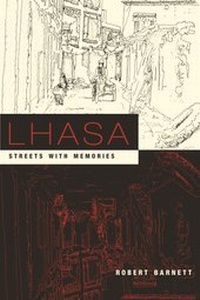
Lhasa
Streets with Memories
Published on 21. February 2006
Book
Hardback
244 pages
978-0-231-13680-8 (ISBN)
Description
There are many Lhasas. One is a grid of uniform boulevards lined with plush hotels, all-night bars, and blue-glass-fronted offices. Another is a warren of alleyways that surround a seventh-century temple built to pin down a supine demoness. A web of Stalinist, rectangular blocks houses the new nomenklatura. Crumbling mansions, once home to noble ministers, famous lovers, nationalist spies, and covert revolutionaries, now serve as shopping malls and faux-antique hotels. Each embodiment of the city partakes of the others' memories, whispered across time and along the city streets. In this imaginative new work, Robert Barnett offers a powerful and lyrical exploration of a city long idealized, disregarded, or misunderstood by outsiders. Looking to its streets and stone, Robert Barnett presents a searching and unforgettable portrait of Lhasa, its history, and its illegibility. His book not only offers itself as a manual for thinking about contemporary Tibet but also questions our ways of thinking about foreign places.
Barnett juxtaposes contemporary accounts of Tibet, architectural observations, and descriptions by foreign observers to describe Lhasa and its current status as both an ancient city and a modern Chinese provincial capital. His narrative reveals how historical layering, popular memory, symbolism, and mythology constitute the story of a city. Besides the ancient Buddhist temples and former picnic gardens of the Tibetan capital, Lhasa describes the urban sprawl, the harsh rectangular structures, and the geometric blue-glass tower blocks that speak of the anxieties of successive regimes intent upon improving on the past. In Barnett's excavation of the city's past, the buildings and the city streets, interwoven with his own recollections of unrest and resistance, recount the story of Tibet's complex transition from tradition to modernity and its painful history of foreign encounters and political experiment.
Barnett juxtaposes contemporary accounts of Tibet, architectural observations, and descriptions by foreign observers to describe Lhasa and its current status as both an ancient city and a modern Chinese provincial capital. His narrative reveals how historical layering, popular memory, symbolism, and mythology constitute the story of a city. Besides the ancient Buddhist temples and former picnic gardens of the Tibetan capital, Lhasa describes the urban sprawl, the harsh rectangular structures, and the geometric blue-glass tower blocks that speak of the anxieties of successive regimes intent upon improving on the past. In Barnett's excavation of the city's past, the buildings and the city streets, interwoven with his own recollections of unrest and resistance, recount the story of Tibet's complex transition from tradition to modernity and its painful history of foreign encounters and political experiment.
Reviews / Votes
Barnett's book is a wonderful read... This is a book that will transfix readers. Booklist [A] brilliant rumination on Tibet's capital. Tricycle Most readers of this fascinating book will finish reading it feeling that they truly know the Tibetan City. -- Lucian Pye Foreign Affairs [Barnett] emerges in these pages as a perceptive and sympathetic observer of a city that has often been described, but rarely understood. -- Isabel Hilton London Review of Books An imaginative and atmospheric book... which will appeal to all those interested in Tibet. -- Wendy Palace Asian Affairs An eloquent account of the changes in the city's geography -- Pankaj Mishra New York Review of Books [This] rumination on the capital of Tibet is the rare book that can draw tears just with its assemblage of neutral, entirely unpolemical facts. -- Pico Iyer TIME Asia "Barnett's ruminations on Lhasa in this slim text are eloquently written, captivating reading, and highly recommended. -- Tom Grunfeld China Review International [A] remarkable book. -- Elidor Mehilli Studies in Ethnicity and Nationalism A fascinating account of Lhasa. -- Ben Hillman The China JournalMore details
Series
Language
English
Place of publication
New York
United States
Target group
Professional and scholarly
Product notice
Trade binding
Illustrations
<B>Halftones: </B>20,
Dimensions
Height: 229 mm
Width: 152 mm
Weight
510 gr
ISBN-13
978-0-231-13680-8 (9780231136808)
Copyright in bibliographic data and cover images is held by Nielsen Book Services Limited or by the publishers or by their respective licensors: all rights reserved.
Schweitzer Classification
Other editions
Person
Robert Barnett is director of the Modern Tibetan Studies Program and adjunct professor of international and public affairs at Columbia University. His books include Resistance and Reform in Tibet and A Poisoned Arrow: The Secret Petition of the 10th Panchen Lama.
Content
Preface A Note on History A Note on Terminology Acknowledgments Preamble 1. The Unitary View 2. Foreign Visitors, Oscillations, and Extremes 3. The Square View and the Outstretched Demoness 4. The City, the Circle 5. Monumental Statements and Street Plans 6. From Concrete to Blue Glass 7. The New Flamboyance and the Tibetan Palm Tree 8. Mestizo 9. The Multilayered Streets Notes Glossary Index
Read the >preface to Lhasa (pdf)