

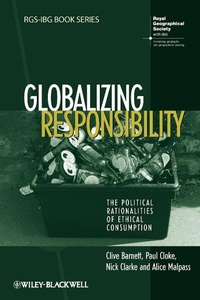
Globalizing Responsibility
The Political Rationalities of Ethical Consumption
1st Edition
Published on 26. November 2010
Book
Paperback/Softback
248 pages
978-1-4051-4557-2 (ISBN)
Description
Globalizing Responsibility: The Political Rationalities of Ethical Consumption presents an innovative reinterpretation of the forces that have shaped the remarkable growth of ethical consumption.
Develops a theoretically informed new approach to shape our understanding of the pragmatic nature of ethical action in consumption processes
Provides empirical research on everyday consumers, social networks, and campaigns
Fills a gap in research on the topic with its distinctive focus on fair trade consumption
Locates ethical consumption within a range of social theoretical debates -on neoliberalism, governmentality, and globalisation
Challenges the moralism of much of the analysis of ethical consumption, which sees it as a retreat from proper citizenly politics and an expression of individualised consumerism
Develops a theoretically informed new approach to shape our understanding of the pragmatic nature of ethical action in consumption processes
Provides empirical research on everyday consumers, social networks, and campaigns
Fills a gap in research on the topic with its distinctive focus on fair trade consumption
Locates ethical consumption within a range of social theoretical debates -on neoliberalism, governmentality, and globalisation
Challenges the moralism of much of the analysis of ethical consumption, which sees it as a retreat from proper citizenly politics and an expression of individualised consumerism
Reviews / Votes
"Globalizing Responsibility: The Political Rationalities of Ethical Consumption presents an innovative reinterpretation of the forces that have shaped the remarkable growth of ethical consumption." (Breitbart.com: Business Wire, 29 November 2010)More details
Series
Language
English
Place of publication
Hoboken
United Kingdom
Publishing group
John Wiley and Sons Ltd
Target group
Professional and scholarly
Product notice
Paperback (trade)
Unsewn / adhesive bound
Dimensions
Height: 229 mm
Width: 152 mm
Thickness: 14 mm
Weight
365 gr
ISBN-13
978-1-4051-4557-2 (9781405145572)
Copyright in bibliographic data and cover images is held by Nielsen Book Services Limited or by the publishers or by their respective licensors: all rights reserved.
Schweitzer Classification
Other editions
Additional editions
Clive Barnett | Paul Cloke | Nick Clarke
Globalizing Responsibility
The Political Rationalities of Ethical Consumption
Book
11/2010
1st Edition
Wiley
€90.00
Shipment within 3-4 weeks
Clive Barnett | Paul Cloke | Nick Clarke
Globalizing Responsibility
The Political Rationalities of Ethical Consumption
E-Book
11/2010
Wiley-Blackwell
€25.99
Available for download
Clive Barnett | Paul Cloke | Nick Clarke
Globalizing Responsibility
The Political Rationalities of Ethical Consumption
E-Book
10/2010
Wiley-Blackwell
€25.99
Available for download
Persons
Clive Barnett is Reader in Human Geography, Faculty of Social Sciences, The Open University. Paul Cloke is Professor of Human Geography, Department of Geography, University of Exeter.
Nick Clarke is Lecturer in Human Geography, Department of Geography, University of Southampton.
Alice Malpass is Research Associate, Primary Health Care, University of Bristol.
Nick Clarke is Lecturer in Human Geography, Department of Geography, University of Southampton.
Alice Malpass is Research Associate, Primary Health Care, University of Bristol.
Content
Series Editors' Preface. Preface and Acknowledgements.
1 Introduction: Politicizing Consumption in an Unequal World.
1.1 The Moralization of Consumption.
1.2 Justice, Responsibility and the Politics of Consumption.
1.3 Relocating Agency in Ethical Consumption.
1.4 Problematizing Consumption.
Part One Theorizing Consumption Differently.
2 The Ethical Problematization of 'The Consumer'.
2.1 Teleologies of Consumerism and Individualization.
2.2 Theorizing Consumers as Political Subjects.
2.3 The Responsibilization of the Consumer.
2.4 What Type of Subject Is 'The Consumer'?
2.5 Does Governing Consumption Involve Governing the Consumer?
2.6 The Ethical Problematization of the Consumer.
2.7 Conclusion.
3 Practising Consumption.
3.1 The Antinomies of Consumer Choice.
3.2 Theorizing Consumption Practices.
3.3 Problematizing Choice.
3.4 Articulating Background.
3.5 Conclusion.
4 Problematizing Consumption.
4.1 Consumer Choice and Citizenly Acts.
4.2 Articulating Consumption and the Consumer.
4.3 Mobilizing the Ethical Consumer.
4.4 Articulating the Ethical Consumer.
4.5 Conclusion.
Part Two Doing Consumption Differently.
5 Grammars of Responsibility.
5.1 Justifying Practices.
5.2 Researching the (Ir)responsible Consumer.
5.3 Versions of Responsibility.
5.4 Dilemmas of Responsibility.
5.5 Conclusion.
6 Local Networks of Global Feeling.
6.1 Locating the Fair Trade Consumer.
6.2 Re-evaluating Fair Trade Consumption.
6.3 Managing Fair Trade, Mobilizing Networks.
6.4 Doing Fair Trade: Buying, Giving, Campaigning.
6.5 Conclusion.
7 Fairtrade Urbanism.
7.1 Rethinking the Spatialities of Fair Trade.
7.2 Re-imagining Bristol: From Slave Trade to Fair Trade.
7.3 Putting Fair Trade in Place.
7.4 Fair Trade and 'The Politics of Place Beyond Place'.
7.5 Conclusion.
8 Conclusion: Doing Politics in an Ethical Register.
8.1 Beyond the Consumer.
8.2 Doing Responsibility.
Notes.
References.
Index.
1 Introduction: Politicizing Consumption in an Unequal World.
1.1 The Moralization of Consumption.
1.2 Justice, Responsibility and the Politics of Consumption.
1.3 Relocating Agency in Ethical Consumption.
1.4 Problematizing Consumption.
Part One Theorizing Consumption Differently.
2 The Ethical Problematization of 'The Consumer'.
2.1 Teleologies of Consumerism and Individualization.
2.2 Theorizing Consumers as Political Subjects.
2.3 The Responsibilization of the Consumer.
2.4 What Type of Subject Is 'The Consumer'?
2.5 Does Governing Consumption Involve Governing the Consumer?
2.6 The Ethical Problematization of the Consumer.
2.7 Conclusion.
3 Practising Consumption.
3.1 The Antinomies of Consumer Choice.
3.2 Theorizing Consumption Practices.
3.3 Problematizing Choice.
3.4 Articulating Background.
3.5 Conclusion.
4 Problematizing Consumption.
4.1 Consumer Choice and Citizenly Acts.
4.2 Articulating Consumption and the Consumer.
4.3 Mobilizing the Ethical Consumer.
4.4 Articulating the Ethical Consumer.
4.5 Conclusion.
Part Two Doing Consumption Differently.
5 Grammars of Responsibility.
5.1 Justifying Practices.
5.2 Researching the (Ir)responsible Consumer.
5.3 Versions of Responsibility.
5.4 Dilemmas of Responsibility.
5.5 Conclusion.
6 Local Networks of Global Feeling.
6.1 Locating the Fair Trade Consumer.
6.2 Re-evaluating Fair Trade Consumption.
6.3 Managing Fair Trade, Mobilizing Networks.
6.4 Doing Fair Trade: Buying, Giving, Campaigning.
6.5 Conclusion.
7 Fairtrade Urbanism.
7.1 Rethinking the Spatialities of Fair Trade.
7.2 Re-imagining Bristol: From Slave Trade to Fair Trade.
7.3 Putting Fair Trade in Place.
7.4 Fair Trade and 'The Politics of Place Beyond Place'.
7.5 Conclusion.
8 Conclusion: Doing Politics in an Ethical Register.
8.1 Beyond the Consumer.
8.2 Doing Responsibility.
Notes.
References.
Index.