

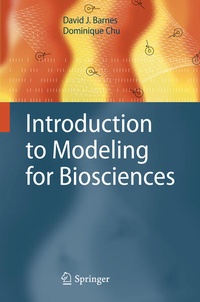
Introduction to Modeling for Biosciences
Published on 4. November 2014
Book
Paperback/Softback
XII, 322 pages
978-1-4471-5907-0 (ISBN)
Description
Mathematical modeling can be a useful tool for researchers in the biological scientists. Yet in biological modeling there is no one modeling technique that is suitable for all problems. Instead, different problems call for different approaches. Furthermore, it can be helpful to analyze the same system using a variety of approaches, to be able to exploit the advantages and drawbacks of each. In practice, it is often unclear which modeling approaches will be most suitable for a particular biological question, a problem which requires researchers to know a reasonable amount about a number of techniques, rather than become experts on a single one.
"Introduction to Modeling for Biosciences" addresses this issue by presenting a broad overview of the most important techniques used to model biological systems. In addition to providing an introduction into the use of a wide range of software tools and modeling environments, this helpful text/reference describes the constraints and difficulties that each modeling technique presents in practice, enabling the researcher to quickly determine which software package would be most useful for their particular problem.
Topics and features: introduces a basic array of techniques to formulate models of biological systems, and to solve them; intersperses the text with exercises throughout the book; includes practical introductions to the Maxima computer algebra system, the PRISM model checker, and the Repast Simphony agent modeling environment; discusses agent-based models, stochastic modeling techniques, differential equations and Gillespie's stochastic simulation algorithm; contains appendices on Repast batch running, rules of differentiation and integration, Maxima and PRISM notation, and some additional mathematical concepts; supplies source code for many of the example models discussed, at the associated website http://www.cs.kent.ac.uk/imb/.
This unique and practical guide leads the novice modeler through realistic andconcrete modeling projects, highlighting and commenting on the process of abstracting the real system into a model. Students and active researchers in the biosciences will also benefit from the discussions of the high-quality, tried-and-tested modeling tools described in the book.
Dr. David J. Barnes is a lecturer in computer science at the University of Kent, UK, with a strong background in the teaching of programming. Dr. Dominique Chu is a lecturer in computer science at the University of Kent, UK. He is an internationally recognized expert in agent-based modeling, and has also in-depth research experience in stochastic and differential equation based modeling.
Reviews / Votes
From the reviews:
"The intersection of biological and computational sciences is well served by this clear, well-written, and interesting guide to the variety of methods currently being used to formulate computational models for biological systems. . the book very accessible to a wide range of readers--from students to experienced researchers--from a variety of backgrounds. . Thus, this volume is very timely. . Overall, this book is an excellent and approachable introduction to biological modeling." (Sara Kalvala, ACM Computing Reviews, May, 2011)More details
Edition
2010 ed.
Language
English
Place of publication
London
United Kingdom
Target group
Professional and scholarly
Research
Illustrations
XII, 322 p.
Dimensions
Height: 235 mm
Width: 155 mm
Thickness: 19 mm
Weight
511 gr
ISBN-13
978-1-4471-5907-0 (9781447159070)
DOI
10.1007/978-1-84996-326-8
Schweitzer Classification
Other editions
Additional editions
David J. Barnes | Dominique Chu
Introduction to Modeling for Biosciences
Book
08/2010
Springer
€74.85
Article exhausted; check for reprint
Persons
David J. Barnes is a senior lecturer in computer science at the University of Kent, UK, with a strong background in the teaching of programming and the implementation of computational models of biological systems.
Dominique Chu is a senior lecturer in computer science at the University of Kent, UK. He is an expert in mathematical and computational modeling of biological systems, with years of experience in these fields.
Content
Foundations of Modeling.- Agent-Based Modeling.- ABMs Using Repast and Java.- Differential Equations.- Mathematical Tools.- Other Stochastic Methods and Prism.- Simulating Biochemical Systems.