


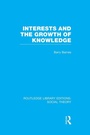
Interests and the Growth of Knowledge (RLE Social Theory)
1st Edition
Published on 8. August 2014
Book
Hardback
122 pages
978-1-138-78741-4 (ISBN)
Description
Intriguingly different in approach from conventional works in the same area of inquiry, this study deals with the central problems and concerns of the sociology of knowledge as it has traditionally been conceived of. In other words, it is concerned with the relationship of knowledge, social interests and social structure, and with the various attempts which have been made to analyse the relationship.
Barry Barnes takes the classic writings in the sociology of knowledge - by Marx, Lukacs, Weber, Mannheim, Goldmann, Habermas and others - and uses them as resources in coming to grips with what he regards as the currently most interesting and significant questions in this area. This approach reflects one of the principal themes of the book itself. Knowledge, it is argued, is best treated as a resource available to those possessing it. This is the best perspective from which to understand its relationship to action and its historical significance; it is a perspective which avoids the problems of holding that knowledge is derivative, as well as those generated by the view that knowledge is a strong determinant of consciousness. the result is an unusual textbook, particularly valuable when read in conjunction with the original works it discusses.
Barry Barnes takes the classic writings in the sociology of knowledge - by Marx, Lukacs, Weber, Mannheim, Goldmann, Habermas and others - and uses them as resources in coming to grips with what he regards as the currently most interesting and significant questions in this area. This approach reflects one of the principal themes of the book itself. Knowledge, it is argued, is best treated as a resource available to those possessing it. This is the best perspective from which to understand its relationship to action and its historical significance; it is a perspective which avoids the problems of holding that knowledge is derivative, as well as those generated by the view that knowledge is a strong determinant of consciousness. the result is an unusual textbook, particularly valuable when read in conjunction with the original works it discusses.
More details
Series
Language
English
Place of publication
London
United Kingdom
Publishing group
Taylor & Francis Ltd
Target group
College/higher education
Dimensions
Height: 240 mm
Width: 161 mm
Thickness: 12 mm
Weight
358 gr
ISBN-13
978-1-138-78741-4 (9781138787414)
Copyright in bibliographic data and cover images is held by Nielsen Book Services Limited or by the publishers or by their respective licensors: all rights reserved.
Schweitzer Classification
Other editions
Additional editions
Book
12/2015
1st Edition
Routledge
€72.60
Shipment within 10-20 days
E-Book
08/2014
1st Edition
Routledge
€67.49
Available for download
E-Book
08/2014
1st Edition
Routledge
€67.49
Available for download
Person
Thomas Lemke is Heisenberg Professor of Sociology with a focus on biotechnologies, nature, and society at Goethe University-Frankfurt/Main in Germany. His research interests include social and political theory, biopolitics, and social studies of genetic and reproductive technologies. His recent publications include Der medizinische Blick in die Zukunft: Gesellschaftliche Implikationen praediktiver Gentests (co-authored with Regine Kollek) (Campus 2008); Governmentality: Current Issues and Future Challenges (co-edited with Ulrich Broeckling and Susanne Krasmann) (Routledge 2010); biopolitics: An Advanced Introduction (New York University Press 2011). You can email him at lemke@em.uni-frankfurt.de.
Content
1. The Problem of Knowledge 2. The Problem of Ideology 3. The Problem of Imputation 4. The Problem of the Power of Knowledge and Ideas