

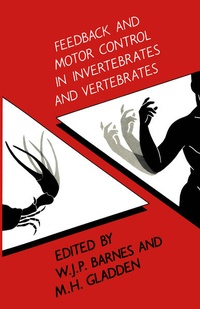
Feedback and Motor Control in Invertebrates and Vertebrates
Published on 3. April 2012
Book
Paperback/Softback
XVI, 496 pages
978-94-011-7086-4 (ISBN)
Description
This book is a collection of papers given by invited speakers at a Symposium on 'Feedback and Motor Control', held at the University of Glasgow from July 10th to 13th 1984, which was attended by over 200 scientists from 20 countries. The Symposium was the Fourth International Symposium organised by the Scottish Electrophysiological Society (SES), and on this occasion the SES joined forces with the Society for Experimental Biology (SEB), so that the Symposium was held dur ing the annual Summer Meeting of the SEB. A policy of the SES since its formation in 1970 has been to promote dialogue between scientists working on invertebrate and vertebrate nervous systems by hol
More details
Edition
Softcover reprint of the original 1st ed. 1985
Language
English
Place of publication
Dordrecht
Netherlands
Target group
Professional and scholarly
Research
Illustrations
XVI, 496 p.
Dimensions
Height: 216 mm
Width: 140 mm
Thickness: 28 mm
Weight
642 gr
ISBN-13
978-94-011-7086-4 (9789401170864)
DOI
10.1007/978-94-011-7084-0
Schweitzer Classification
Other editions
Additional editions
E-Book
12/2012
Springer
€96.29
Available for download

Jon Barnes | Margaret Gladden
Feedback and Motor Control in Invertebrates and Vertebrates
Book
12/1985
Kluwer Academic Publishers
€109.13
Article exhausted; check different version
Content
Section 1: Organisation of Motor Systems.- 1 Introduction.- 2 Central feedback loops and some implications for motor control.- 3 Neural control of vertebrate locomotion-central mechanisms and reflex interaction with special reference to the cat.- 4 Generation of behaviour: the orchestration hypothesis.- 5 Convergence of several sensory modalities in motor control.- 6 Feedback control of an escape behaviour.- Section 2: Central Control of Sense Organ Excitability.- 7 Introduction.- 8 Intrafusal muscle fibres in the cat and their motor control.- 9 How do crabs control their muscle receptors?.- Section 3: Afferent Input During Normal Movements.- 10 Introduction.- 11 What the cat's hind limb tells the cat's spinal cord.- 12 Proprioceptive feedback and the control of cockroach walking.- Section 4: Reflexes.- 13 Introduction.- 14 Stretch reflexes in man: the significance of tendon compliance.- 15 The synaptic basis for integration of local reflexes in the locust.- Section 5: The Control of Equilibrium.- 16 Introduction.- 17 Control of eye-head coordination by brain stem neurones.- 18 Multisensory interactions in the crustacean equilibrium system.- Section 6: The Control of Movement.- 19 Introduction.- 20 Are there central pattern generators for walking and flight in insects?.- 21 The role of movement-related feedback in the control of locomotion in fish and lamprey.- 22 How locusts fly straight.- 23 Interactions of segmental and suprasegmental inputs with the spinal pattern generator of locomotion.- 24 Stepping reflexes and the sensory control of walking in Crustacea.- Section 7: Feedback and Motor Control in Man.- 25 Introduction.- 26 Proprioceptive activity from human finger muscles.- 27 Human long-latency stretch reflexes - a new role for the secondary ending of themuscle spindle?.- 28 Phase dependent step adaptations during human locomotion.- 29 Abnormal feedback and movement disorders in man, with particular reference to cortical myoclonus.- Author index.